Spring cleaning has me
in the darkest corner
of the sunroom with a
stick in hand, wrapping
old webs around the far end
like drab cotton candy.

The spiders staked
their claim last fall,
orb-weavers, I think. I
didn’t get too close,
and nights were longer and
cooler and spent indoors,
so I let them have the corner.

When I reclaim it on a warm May
day, the abandoned webs cling
listlessly to wall and screen
and bench and reach as if alive for
the oar I offer from a far shore.

The weaver of the orb
mustn’t mind rebuilding her home.
It seems to be the point, to start
again from the beginning.

The cardinal builds a new
nest every year, sometimes
even twice.
Moles burrow constantly and
don’t use the same tunnel again.

The hostas in my front yard disappear
completely each winter and always
come back, from a tiny green peek
through the dirt to a maturity even
grander than before, fueled by
energy both fresh and remembered.

Everything starts over.  Life
is not always added to.
It is sometimes
begun anew.
Over the past few months, I’ve dropped some weight — about 30 pounds now from my highest point. And 30 pounds is a lot. For perspective, a jug of milk weighs about 8.6 pounds. So if you could pick up approximately three-and-a-half gallons of milk, that’s how much weight I’ve lost. My knees and my heart and my belt all are quite happy about this.
So is my spirit.
Now, let’s get one thing clear right from the start. This isn’t some kind of body-shaming, finger-wagging, skinny=sacred kind of post. We don’t play that. This is about Deb.
And it’s about that diagram above. Notice that the triquetra isn’t divided into body-mind-spirit as is usually done. Instead, the human triad is body-mind-emotions, and all of that is contained within the spirit — our sacred essence that is, ultimately, the I AM that I AM and YOU ARE.
Our Sacred Self is unchanging. It wasn’t born and will not die. It is Infinite Joy, Boundless Love, Perfect Peace. So how could a few pounds here or there have any impact?
We pay attention to our physical, emotional, and mental health not because the Spirit suffers if we don’t, but because our ability to clearly connect with our higher Self can be inhibited. We remove layers of distraction, layers of attachments so we may become awake to and aware of our true Self.
This is why yoga includes asanas, the postures that are merely a part and that many in the West believe are the whole of yoga. If you’ve ever wiggled and squirmed through meditation because your body felt uncomfortable, it may be because you didn’t stretch and prepare the body for its role in attaining sacred stillness.
My weight loss began slowly and wasn’t initially connected to this understanding. As the months passed, I added a daily yoga practice to my newly focused attention on what I ate. Despite my Aries tendency to DO ALL THE THINGS RIGHT NOW, I discovered that ten minutes a day, every day, is better than an hour once a week which soon is dreaded and eventually falls by the wayside. My ten-minute asana practice is followed by a five-minute silent meditation. Just five minutes. (Note: I meditate at other times of the day and sometimes for longer, but that’s of no importance — five minutes is fine.)
My body has become an important part of my spiritual practice. I am responding to it as it needs and in the best way I can for me. I take care of it so that when I need it to be still, it listens. Your response to your body may look completely different. In fact, I would say it absolutely should. But I encourage you to start somewhere. Start small. Really small. Small and big are irrelevant to Spirit.
Remember that the most important part, the only part that matters, in fact, is the Oneness with Divine Presence. Anything that serves this alignment is a sacred practice.
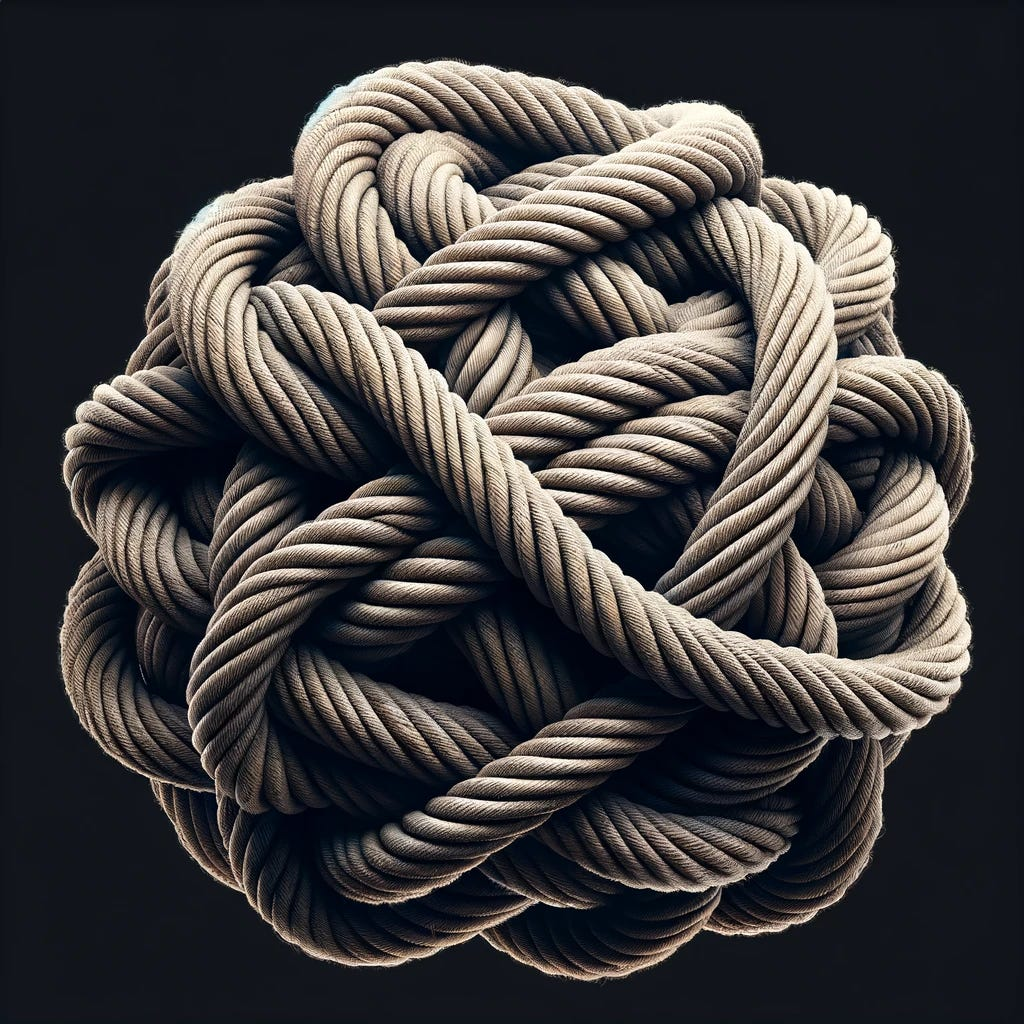
Quick story — in 333 BC, Alexander the Great, who at the time was still merely Alexander the Mildly Impressive, was challenged to untie a complex knot that tied an oxcart. Legend had it that whoever could untie the knot would be destined to rule all of Asia. Alexander took his sword and dramatically cut the knot in half. Problem solved.
The most complex problem I’ve encountered in spiritual evolution is the problem of attachment. It is the knotty topic I find myself returning to time and again in my own practice and the one I get most questions about from others. It is the sticky wicket of awakening.
The idea of releasing attachment is often misinterpreted as relinquishing what we love. We become afraid that our spiritual journey will demand the sacrifice of happiness, excitement, and the delicious joy of anticipation. Even after we become fully aware that the world of spirit has no push or pull, no up or down, no craving or aversion, we wonder what we might miss without them.
The attachment to even one craving or one aversion becomes a Gordian knot tying our beingness to ego.
But never fear — the metaphor stretches.
The sword that slices through the knot is joy. You see, the great mystical paradox of non-attachment is that we actually make room for more joy. So many parts of this human life are gloriously fun and immensely thrilling. Do all of them, if you wish. Non-attachment never asks you to say no to glorious fun. The attachment is not in the event we crave — it’s in the craving. Whatever you might look forward to, try releasing everything about it except the joy. That means releasing the need for it to happen and the need for it to happen in a certain way. Most importantly, it means releasing the belief that this event is the dispenser of your joy.
True joy exists independently of any happening in the dynamic push-pull, up-down world of material reality. If I go on that trip of a lifetime or not, if I get that new car or not, if I can buy that dream house or not — still joy.
We used to sing a song in Sunday School that borrowed lyrics from a verse in the Old Testament book of Nehemiah. It said, “The joy of the Lord is my strength.” It’s still a maxim that rings true even in my non-traditional, interfaith, syncretic journey. The joy of spirit is my sword. It cuts through every knotty attachment and sets me free.
Just to bring the three people who haven’t heard about the man and the bear up to speed:
A woman on social media asked her husband if he would rather have their daughter alone in the woods with a bear or a man. You can see his tortured thought process in the brief video. What kind of man? Can I pick the man? How far away is the bear? When his wife shifts the question to whether he would want his daughter in the woods with a bear or a woman, he doesn’t hesitate — “A woman.”
The internet has erupted with this conversation, and women are saying a LOT:
“Now you know why we walk to our car with our keys between our fingers like wolverine claws.”
“The bear won’t try to convince me he’s a friend before he attacks me.”
“At least people won’t question whether I led the bear on or dressed too provocatively.”
Men also have a few things to say, but their defensiveness often proves the point. One meme shows a cartoon man walking away from a woman being mauled by a bear and saying, “Hey, you chose the bear.” That’s not quite the flex the meme creator believes it is. Implying that women should be mauled for seeing you as a danger makes you . . . dangerous.
But this question really isn’t about men. It’s about maleness, and more specifically, toxic masculinity. It’s about years of patriarchy, both social and religious, that have created an extreme imbalance of energy. It’s about the way we belittled and buried the necessary qualities of feminine energy — gentleness, intuition, non-hierarchical collaboration, receptivity, nurturing — and emphasized the masculine energy — leadership, assertiveness, power, strength, protection.
It’s important to remember that female and feminine are not synonymous. In the same way that my Aries nature often causes me to express as an assertive and strong woman, many men I know excel in following their intuition and nurturing those around them. Those men in touch with their feminine energies seem remarkably silent in the man-and-bear debate. It’s almost as if . . . they get it.
In religious circles, the slow recognition of the need for more divine feminine energy has sometimes led to a placebo that seems to have an effect for a time but doesn’t really heal. I’m talking about women in leadership. The answer to so many well-intentioned religious organizations who want to balance patriarchal energy is to put more women in leadership. But, if those women have been steeped in the same masculine soup of traditional religiosity, they are likely to perpetuate the divine masculine because they have learned that’s how you survive and succeed.
Eastern religions have long revered the divine feminine. Perhaps that is why their popularity in the West has grown so impressively over the past several decades. People may not always be able to put it into words, but when droves run from a religion that systematically reduced the role of women, Mary Magdalene in particular, and move toward wisdom traditions with goddesses and yin-yang balance, it seems a connection could be made to the yearning for balance.
You see, the real question is bear or toxic masculinity, and we’d all be better off with the bear, women and men alike.
And for those men who don’t know how to respond to the man v. bear question, here’s a suggestion: Don’t. Just listen. Acknowledge that women are generally terrified of toxic masculinity. And work to balance your feminine energy so you’re the Gentle Ben who would protect those around you.



 Deb Moore