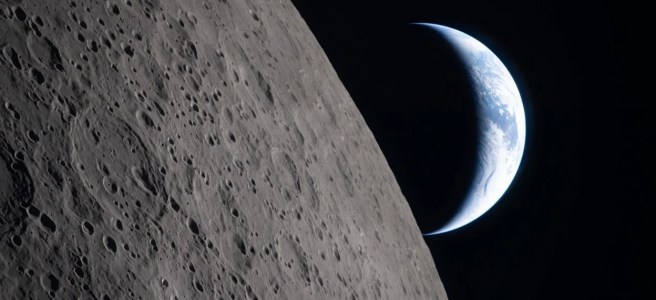
Oh, To Have Been ‘Round the Moon

How jealous we all were of the crew of Artemis II. To leave this third rock for even an abbreviated fortnight, to see the world without borders, to be pleasantly news-less.

We think we live in unprecedented times. On one hand, we do, and on the other, these times are grossly precedented. We still fight over religion and land and power and politics, like the ancient Sumerians and Egyptians did. Like the Britons and Vikings did. Like the Muslims and Christians did. Oops . . . do.

The only path to peace I know in the midst of it all is to regularly and meaningfully transcend. Exit the gravitational pull. Step away. The Buddhist Heart Sutra gave us the perfectly concise mantra Gate, Gate, Paragate, Parasamgate, Bodhi Svaha. The meaning is simple: Gone, gone, gone beyond, gone completely beyond. Oh, what an enlightenment.

The most consistent question I receive as an interfaith minister is the question of how we live in this world, how we juggle politics and family, how we maintain bliss in the face of chaos. SHOULD we maintain bliss in the face of chaos. Honestly, I don’t have one go-to answer. I often respond based on how the day feels, what has been shown to me, and/or how the inquiry is couched. I do think we have to be artful with this question — what works one day may not be the next day’s answer.

I do know, however, that the way to be ready for what each day holds is to remember who we are, go into the silence, enter the inner spaciousness where Divine Presence lives in us as us. Succumb to the stillness. Sit still and listen with ears of the heart.

The German poet, Rainer Maria Rilke, wrote a poem that serves as a good reminder of what is real in the beyond. Here it is translated into English by Stephen Mitchell:

BUDDHA IN GLORY

Center of all centers, core of cores,
almond self-enclosed, and growing sweet—
all this universe, to the furthest stars
all beyond them, is your flesh, your fruit.

Now you feel how nothing clings to you;
your vast shell reaches into endless space,
and there the rich, thick fluids rise and flow.
Illuminated in your infinite peace,

a billion stars go spinning through the night,
blazing high above your head.
But in you is the presence that
will be, when all the stars are dead.

March Madness Zen

I used to be a sports fan.

My father had been a star athlete in high school, and his coulda-woulda-beens came out in the form of teaching me the games as we watched on our black-and-white TV, then the color TV, then cable. Because of him, I could spot a foul before the whistle blew and confidently yell at the screen when the refs so obviously got it wrong.

He taught me basketball, baseball, and football. With those transferrable skills, I picked up on hockey, golf, tennis, and soccer with relative ease.

Then, at some point in my early 30s, I stopped watching all of it. It didn’t happen all at once. I started to become concerned about the potential brain injuries in football. I became increasingly sensitive to the angry atmospheres of basketball arenas and hockey rinks. I began to see championships as exercises in futility followed immediately by the 0-0 record reset. What was the point? So, gradually, I stepped away from sports completely.

I blamed my spiritual journey. A world of win-loss competitiveness didn’t seem compatible with non-duality. And the inability to endure the vitriol of a live game atmosphere seemed to share DNA with the hours I had accumulated spent in meditation. I had evolved, and athletics were clearly happening on the level of base materialism.

Then the world started to fall apart. One Trump term, a worldwide pandemic, a second Trump term, a direct attack on DEI, a gross lack of compassion, an entire generation of social security recipients facing a fear they never imagined, . . . the list is endless, it seems. I can’t hide under a rock and ignore it, but my sanity can’t take a steady drip of horrible news. I can’t meditate 24 hours a day, but I also can’t survive engaging in life in continually demoralizing ways.

And then I turned on a basketball game.

For a couple of hours, I focused solely on the Memphis Grizzlies. The understanding of the game instilled in me by my father returned with gusto. Most importantly, I was 100% PRESENT. I was in the moment. The very brass ring I reached for in meditation was the free gift of sportsball.

So I’ve filled out not one, but four NCAA tournament brackets — two each for the women’s and the men’s tournaments. I’m taking my wife to her first live NBA game in a couple of weeks. I’m a proud supporter of the basketball, baseball, and softball teams at the community college where I work. And I’m already excited about Vandy football this fall.

I am once again a sports fan. Who meditates. A double-header.

The Whole Self

Over the past few months, I’ve dropped some weight — about 30 pounds now from my highest point. And 30 pounds is a lot. For perspective, a jug of milk weighs about 8.6 pounds. So if you could pick up approximately three-and-a-half gallons of milk, that’s how much weight I’ve lost. My knees and my heart and my belt all are quite happy about this.

So is my spirit.

Now, let’s get one thing clear right from the start. This isn’t some kind of body-shaming, finger-wagging, skinny=sacred kind of post. We don’t play that. This is about Deb.

And it’s about that diagram above. Notice that the triquetra isn’t divided into body-mind-spirit as is usually done. Instead, the human triad is body-mind-emotions, and all of that is contained within the spirit — our sacred essence that is, ultimately, the I AM that I AM and YOU ARE.

Our Sacred Self is unchanging. It wasn’t born and will not die. It is Infinite Joy, Boundless Love, Perfect Peace. So how could a few pounds here or there have any impact?

We pay attention to our physical, emotional, and mental health not because the Spirit suffers if we don’t, but because our ability to clearly connect with our higher Self can be inhibited. We remove layers of distraction, layers of attachments so we may become awake to and aware of our true Self.

This is why yoga includes asanas, the postures that are merely a part and that many in the West believe are the whole of yoga. If you’ve ever wiggled and squirmed through meditation because your body felt uncomfortable, it may be because you didn’t stretch and prepare the body for its role in attaining sacred stillness.

My weight loss began slowly and wasn’t initially connected to this understanding. As the months passed, I added a daily yoga practice to my newly focused attention on what I ate. Despite my Aries tendency to DO ALL THE THINGS RIGHT NOW, I discovered that ten minutes a day, every day, is better than an hour once a week which soon is dreaded and eventually falls by the wayside. My ten-minute asana practice is followed by a five-minute silent meditation. Just five minutes. (Note: I meditate at other times of the day and sometimes for longer, but that’s of no importance — five minutes is fine.)

My body has become an important part of my spiritual practice. I am responding to it as it needs and in the best way I can for me. I take care of it so that when I need it to be still, it listens. Your response to your body may look completely different. In fact, I would say it absolutely should. But I encourage you to start somewhere. Start small. Really small. Small and big are irrelevant to Spirit.

Remember that the most important part, the only part that matters, in fact, is the Oneness with Divine Presence. Anything that serves this alignment is a sacred practice.

Even calorie counting.

To Be . . .

. . . or not to be. 

Should I stay or should I go? 

These two roads diverging in the woods . . . which one should I take? 

It often seems that life is just a series of choices and their consequences.  In retrospect, a choice can seem destined and profound, the initiating event of what came next.  Or perhaps it is married to regret and remorse.  Ideally, whether seen in the rearview mirror as positive bellwethers of future good or as negative gatekeepers to coming pain, our choices set the stage for everything else to come. 

Robert Frost’s poem “The Road Not Taken,” about those roads diverging in the woods, is often used to demonstrate the beauty of not following the crowd.  The final lines of the poem say, “Two roads diverged in a wood, and I — I took the one less traveled by, and that has made all the difference.”   But, these are perhaps the most misinterpreted lines in all of American poetry.  We think they’re saying “Ah, what a glorious rebel I have been, and it paid off.” 

But, you see, the two roads described aren’t that different from each other.  The poem says “the passing there had worn them really about the same” and that the roads “both that morning equally lay.” Frost’s final stanza starts “I shall be telling this with a sigh somewhere ages and ages hence,” and that “with a sigh” is important. He’s actually writing about our tendency to romanticize the past, to look back at younger selves as courageous and daring rather than just . . . human, making human choices, and having no more idea than anybody else how it might all turn out. 

The rightness or wrongness, goodness or badness of our choices is often determined by the way we move through the results of our choice rather than the choice itself. 

But while we’re still on the front side of the choice, still standing at the fork in the road, is there any way to get a sense of direction? 

I was once faced with a big decision and unclear how to make it. My sister gave me some good advice.  She said, “Get off by yourself where you won’t be interrupted. Spend a few moments in meditation. Quiet your mind. When you feel completely settled within yourself, take your mind to the place where you have already decided on option A, and see how you feel.  Then clear your mind again and take it to the place where you have already decided on option B, and see how you feel.” 

So, I did it.  I followed her advice.  And you know what? I knew exactly what to do. My intuition, my inner guidance, my emotional self did not let me down. It sent me a clear message. 

Ultimately, though, whichever choice I made was mine. My choices are a primary way in which I co-create my life.  Should I stay or should I go? No one can tell me . . . but me. And by “me,” I mean the higher version of me that lives in the quiet places.
