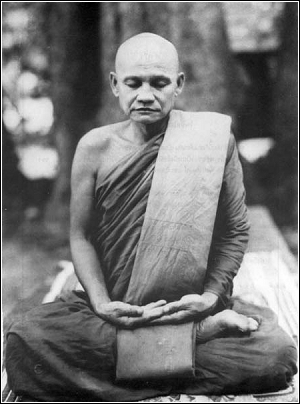
Letting Everything Go

Ajahn Chah (1918 – 1992)

Letting everything go is the spiritual concept I return to over and over. I have spiraled up through the years, elevating my consciousness, but always returning, again and again, to the need for something to be released and the lessons brought by letting go.

The practice of releasing attachments started as a wall against which to kick and scream and beat my head. Over time, it became a closed-bud promise, the kind I knew would bloom one day but still tightly shut against full surrender. Eventually, ever so slowly, the lotus began to open, and wisdom wafted forth like a fragrance in the air.

The Thai Buddhist monk, Ajahn Chah, said, “When the heart truly understands, it lets go of everything.” For me, the opening of the lotus was initiated by the first part of that sentence. During times when releasing everything seemed downright impossible or even a bit irrational, I would choose to focus on a deep and consuming desire for a heart that truly understands. If I couldn’t quite let go, at least I could lean into love. And when I couldn’t do even that, there was always grace.

Grace is when our hearts feel the pull of the divine even while we maintain our death grip on our ego’s desires. Grace is the sacred ability for even our attachments to become guideposts to spiritual awakening. Grace is knowing we are only love even while still feeling the pull of our needs and wants and attachments.

Ajahn Chah also said, “Anything which is troubling you, anything which is irritating you, THAT is your teacher.” And the primary lesson it teaches us is that all the time we’re thinking it has its claws in us, we actually have our claws in it. We can open our hand, open our heart, and learn once again the freedom of letting go.

And when we’ve let go of everything, . . . then we are free.

Who Are You?

I don’t mean the famous question from the band The Who, the one that sounds like it’s being answered by an owl.  I really want to know . . . who are you? 

When we’re faced with that question, we often begin with our labels.  I’m a teacher. I’m a musician. I’m an artist. I’m an insurance agent. I’m a carpenter. Even our name is really just a label. 

But do those labels answer the question? Who are you? Really? If you stop being a teacher, you don’t stop being.  If you stop being a carpenter, you still exist. You could abandon even your name and still be. 

Those labels are like nesting dolls, those Russian wooden dolls that, when pulled apart, reveal a slightly smaller version of the same doll, which can be pulled apart revealing another slightly smaller doll, and so on. In the same kind of way, we add layer and layer of identity until we forget who we really are and begin to identify with the shells.  

According to many great spiritual teachers, who you are is none of the things that you might use to uniquely define yourself. Those specific parts of your personality, your talents, your intelligence, your sense of humor, might be how you express yourself in the world, but they are not the essence of you.

Our lives begin as a purity of essence that quickly gets covered up. Our parents give us a name. They begin immediately to tell us who we are.  “You’re so pretty.” “Oh, what big eyes.” “Such a sweet smile!” We first know ourselves as seen through the eyes of our caregivers. They are our first mirrors. As we grow, we take on more identifying features. We get them from family and friends and teachers and television and bullies and . . . ourselves until we have completely covered that essence.  Many of us eventually reach a moment when we decide we want to know who we really are deep down inside. This is often initiated by crisis, a dark night of the soul, a collapse of our ego’s scaffolding. 

Advaita Vedanta is the school of Hinduism that focuses on non-duality. It holds that pure consciousness, what Hindus call “Brahman,” is the only reality.  That single reality, that non-dual reality, is unified Divine energy that is the life force in all creation.  There is no dual you and I or I and God. There is only one life. It is nature. It is Divine. It is you. It is me. 

Advaita Vedanta teaches that we are made up of five layers, called koshas. Kosha literally means “sheath,” or you could think of it as a cloak. Like nesting dolls, we wear these cloaks over our Divine Essence.  The first cloak is the physical body.  It is the dense material cloak. The second kosha or cloak is the energy body. This is the layer where the chakras and the divine meridians are located. The third cloak is the mental and emotional layer. The fourth is the wisdom layer. The fifth is the layer of bliss. Vedanta yoga often ends there, though some teachers add the sixth layer, and this layer is referred to as the True Self.

Uncovering this essence, our true self, is our spiritual work.  We are not in search of something because we already are that which we think we’re searching for. 

Who are you? You are pure love, pure peace, pure Divine Presence. You are this pure essence even when you can’t see it for all the layers covering it. You are the you are. I am the I am.
