Rose and Justice — Installment Eight

This is Installment Eight of the novel Rose and Justice. It includes Chapters II.xi and II.xii. It is 3,503 words long. As installments are posted, links for each will be added under the tab labeled “The Novel” at the top of this page. Enjoy!

II.xi

Rose Jackson sat in the low crook of the live-oak where she did all her best reading.  She was only five and yet was happiest alone with a good book.  Phillip had become concerned with her in the last year.  She had withdrawn.  She was not moody or depressed — she always had her ready smile for him every time he saw her — she had just moved inside herself, somewhere so deep that Phillip couldn’t reach it.  She was a child like no other he had ever known — no, she was a person like no other he had ever known.  He often felt that she was older than him.  She saw the world in a way he thought he could only dream of.  In one way, Phillip felt he was losing his daughter.  In another, he felt he could be closer to her than ever if he listened to her every word as Plato had listened to Socrates.

Rose was reading Keats.  Her five-year-old mind didn’t quite understand all he was trying to say, but something in her spirit was drawn to his rhythms and his words.  Her reading choices were always an interesting mix of Romantic poets and Nancy Drew.  She was as likely to bring Thomas Hardy home from the library as she was the Hardy Boys.  She had outgrown Dr. Seuss by three and now bounced between Charlotte’s Web and The Canterbury Tales with an ease that indicated an intelligence beyond her parents’ ability to recognize it.  Marabelle was half-convinced there had been a switch in the maternity ward.  The only thing she knew about Keats was that his first name was John.  And if you had asked Phillip if he knew Keats, he would probably look pensive, scratch his chin, and say, “Didn’t he play shortstop for the Dodgers?”  But Rose had asked for a library card for her fifth birthday.  Marabelle had been only shocked; Phillip was downright speechless.  He prodded her for other hints — the latest doll, an Easy-Bake oven — but she merely replied that she “would like a library card, please.”  Phillip and Marabelle had purchased a few toys and items of clothing, mostly to appease themselves, but Rose didn’t light up until her father handed her a library card in her own name.

Phillip took her to the library every Saturday morning before their weekly lunch together at a fast-food restaurant.  She would not read her newly checked-out books over lunch.  That would be rude and, even at five, Rose was anything but rude.  But she would take them in the restaurant and stroke the covers like they were made of silk while eating her hamburger.  Phillip knew that she couldn’t wait to get home and climb up in “her” tree with her latest literary acquisition, so he ate his burger quickly and drove her back to the house.  He would often sit in the den and watch her perched in the live-oak, wondering what else she was learning and how much he still didn’t know about her.

Rose concentrated on the page as she always did.  From the time she had learned to read, she had been able to focus completely on the words in front of her without even seeming to be aware of any distractions around her.  She was like a little adult in her ability to still herself — no, she was much better at it than most adults.  She almost seemed able to control what her brain acknowledged, not even processing that which she wished to ignore at the moment, yet allowing those things she needed to be aware of to enter her gray matter.  That was how she was able to read at a level of deep understanding and still hear her mother call her when supper was ready.

But as she sat in the tree on this particular Keats afternoon, she was startled by a sudden lack of concentration.  The words slowly became fuzzy.  At first, she was not even aware that she had drifted away from the poem.  Her eyes steadily raised until she was staring over the book at the Magnolia tree in the far corner of the yard.  She felt something, she couldn’t say what, but she knew that a subtle change had just come over her.  The poetry became unimportant in that instant.  Deep within her a stirring began, a movement in her soul that somehow told her that from this moment her life would be about something different than it had been about before.  She sensed a presence, a feeling that she wasn’t alone.  She had no idea what it all meant, but she just knew something had changed.  She knew that this something was elusive, but she also knew that she had to find what it was even if it took her whole life.

II.xii

Jared Malone sat on the top step of the wooden porch surrounding his cabin.  He stared at the gray Spanish moss that hung from the live oaks surrounding the cabin clearing, but didn’t really see it.  Instead he saw the ocean.  That mental image was the handiest for him if he wanted to avoid what was immediately around him.  If he had been paying conscious attention to the screaming coming from inside his house, he would have walked down the path to the tower almost a quarter mile away, climbed it, and actually seen the ocean.  But he had long ago learned to block out what he didn’t want to be aware of, and so the screams existed only on the dark and hazy fringes of his consciousness.  In his trance of imaginary water, he thought about surprisingly mundane things — checking the fence on the north side of the property, getting with Tom about the night watch schedule, what was needed on the weekly supply trip.  He did not think about his child being born.  Nor did he think about the agony that Melinda was enduring as she attempted to give birth without the benefit of drugs.   Betty Vale, acting as midwife, had given her two large shots of Jack Daniels.  It might as well have been water — at least then she wouldn’t be so damn thirsty.

Jared took a long swig from the half-empty bottle of Jack he held loosely in his right hand.  It was the same bottle the midwife had confiscated moments before for “medicinal purposes.”  The bottle he now held was the closest thing he had to a connection with his wife’s birthing experience.  It was the closest he wanted to get.  Jared held ideas in his mind that had nothing to do with the times in which he lived; they were direct descendents of the ideas held for Malones for at least five generations.  Like the land he owned outright since his father passed away the previous spring, Jared’s thought processes were his birthright, his inheritance, and the legacy he would pass on to his own son.  It was sure to be a boy.  Malones always had boys, and Jared was the manliest of the Malones.  Incorrectly assuming that the gender of his child was directly attributed to his own level of testosterone, Jared didn’t even consider the possibility of a girl.  As he took another swig of bourbon, his trance broke and he heard Melinda clearly for the first time.  He stood slowly and arched his back in a stretch then ambled away from the cabin down the tower path.  In his mind, having babies was as much women’s work as cleaning toilets, and he wanted nothing to do with it.  In fact, he now felt a little odd at having been that close to the process as long as he had.

The path to the tower was famous in the Malone family history.  It had been a deer path centuries before, then used by the Creek tribesmen who used to roam freely in Southern Georgia.  After that, the Spanish had traveled it until James Oglethorpe, the British general central to so much of Georgia’s history, had fought for and won the path and the Island with the help of British regulars and Scottish Highlanders from Darien.  After the Revolutionary War, great plantations sprung up on the island and planters on horseback used the path to travel between Kelvin Grove and New St. Clair.  There had never been any attempt made to drastically alter it.  Jared’s father had put boards across the low spot where marsh water tended to back up, but other than that the only changes to the path were created slowly through use.  This path was the oldest on the property and most well preserved.  Other paths had been carved out over the years and access roads had been cleared and graveled, but the tower path was almost sacred.  Jared would never allow it to be tampered with.

Every time Jared walked the path, at least twice a day, he thought of his father and his grandfather.  It was along this path that the adolescent Jared heard the stories of his family heritage, and it was on this path that he had followed his male ancestors, both living and dead, a million times to fish for mullet and kingfish in the tidal rivers and marshes that were the offspring of the Atlantic.  It was here that he had walked, .22 rifle over his shoulder, in search of the rabbit, squirrel and deer which would feed his family.  The west side of the compound was mostly salt marsh.  Along this part of the path, Jared had spent his life among herons and egrets, competing with them for shrimp and oysters.

His family had escaped the Scottish Clan Wars and come to the new world generations before.  His distant ancestor, a grandfather with about eight greats in front of the title, MacDonald Malone, had been a corporal with the Darien Highland Independent Company, the same Scotsmen who came to the aid of the British and helped drive out the Spanish at the Battle of Bloody Marsh.  MacDonald Malone returned to Darien and raised up good little Scotsmen for several generations.

Jared’s great-great-great grandfather, Marshall Malone, was a gambler of considerable talent.  During a high stakes poker game in Brunswick, he had won 250 acres of Kelvin Grove off an intoxicated James Postell.  The planter was not typically much of a drinker, preferring to collect seashells instead, and considered the rare inebriated gambling episode the greatest shame of his life.  But, he was a gentleman and determined to make good on the bet he could have easily covered with cash.  He promptly deeded to Marshall Malone the 250 most useless acres of his 1600-acre plantation, mostly salt marsh, almost uninhabitable.

With the stubbornness of a good Scotsman, Marshall carved out an existence on what few high spots he could find on the land.   He would be damned before he admitted he really hadn’t won much off the bet.   The great irony of the situation was that the land he had won included the site of the Battle of Bloody Marsh, the same conflict his earlier ancestor had fought in so bravely.  It was also the twist that would set the Malone family on a path of hatred and distrust.

Marshall Malone had been raised with the stories of how his family had owned fertile and abundant land in Scotland that had been stolen from them.  The legacy he received was a love of land second to no other love in his life, not even the half-Creek woman he had married.  Maris was a gentle woman who had the native appreciation of land, an appreciation that could not conceive of the concept of land ownership.  The land was not to be owned.  It was to be used, replenished, cherished, and protected.  Both of them loved the land, but from different ends of a spectrum.  Maris wished to give to it and receive from it.  Marshall wanted to possess it and guard it.  And this he taught to his son, who felt it deeper and taught it to his son, who felt it deeper and taught it to his son.  Jared’s father had just taken full possession of the land after the early and sudden death of Jared’s grandfather when the government condemned and purchased just over 200 acres of the Malone family property for an historical battle site park and protected wetland reserve.  They had been paid well, but no amount of money could ease the pain and anger that began to blossom like a cancer in the Malone family tree.

With the money from the federal government, Jared’s father built a twelve-foot wall around the remaining 48 acres in the areas where the marsh didn’t make it impossible.   And started buying guns.   Jared was the fifth generation of Malone men to occupy the 48 acres of loblolly pines, saw palmetto, live oaks, and salt marsh, land not really good for anything except owning.  Once a contractor had approached Jared about selling, but Jared had simply escorted the overdressed man off his property, ready to do so at the point of a gun if necessary.

By the time Jared was eighteen, he had inherited a burning hatred of the government and just about everyone and everything that did not conform to his view of the way the world should be.  He began to accumulate a small group of friends that more closely resembled a band of followers.  As each one joined Jared’s circle, a cabin was built on the property.  Melinda and the other wives came from the same pool of like-minded people and accepted completely the men’s total dominion over their lives, thoughts, and actions.  That was the only way it could have worked.

When Jared was 24, his father died the same kind of unexpected early death of his father before him.  By the time Jared turned 25, there were 10 people living on his compound.  Bob Vale and his wife, Betty, lived in the cabin closest to Jared’s.  In a clearing 200 yards away were two more cabins where the others lived — Jared’s brother, Aaron, and his wife, Mary; and Clete Camden, his wife, Cherise, and their four-year-old son, Clete, Jr..  Several storage buildings completed the small village, including what could only accurately be called an armory, where guns and ammunition were kept, inventoried, and regularly added to.

The men took turns hunting game, fishing the marshes and seining for shrimp, digging wells, maintaining the buildings, and standing guard against some imagined enemy.  The women sewed, cooked, cleaned, chopped wood, bore children, and attended to every personal need of the men.  They grew everything they ate, kept 4 – 5 cows at any given time for milk and meat, raised pigs and chickens, and managed to keep a six-month supply of meat in the smokehouse.  They lived in a prison of time, not progressing with the rest of the world and, in fact, completely resistant to anything that resembled a break with Malone tradition.

Once or twice a month, Jared and the other men would go into Brunswick and stock up on essentials they couldn’t grow — flour, sugar, corn meal.  They could have gotten everything they needed on the island, but Jared was paranoid about island residents knowing anything about him or his compound.  He insisted on going to Brunswick and feeling the comparative anonymity brought on by crossing the Frederica River.  The money for these few supplies always came from Jared’s pocket.  He never had a lot on him, but always enough, and no one questioned where this seemingly endless supply came from.    When each new member joined Jared’s little group, they added whatever money they had to the pot.   Beyond the supplies, the only expenditures were for guns, ammunition, and occasionally a johnboat or four-wheeler.  Jared was the undisputed leader and in control of all assets and decisions.  By 27, as he waited for his first child to be born, Jared was the master of a small empire of unknown worth.

He reached the end of the path and climbed the wooden ladder to the platform 25 feet in the air.  His brother, Aaron, was standing watch.  Aaron had his back to the ladder, automatic rifle over his shoulder and a pistol in his holster, as Jared climbed as silently as a cat onto the platform.  He came up right behind Aaron, stood almost breathing on his neck for a long moment, then grabbed Aaron’s left arm and wrenched it behind his back while reaching around to pin his right arm to his chest, all in about a half second.

“What the fuck?”  Aaron struggled, then turned as Jared released his grip.  “Goddamn it, Jared.  You scared the shit out of me.”

“I’m kinda’ worried about you, little brother, lettin’ somebody sneak up on you like that.  It may not always be your brother doin’ the sneakin’.  You’d do well to remember that.”

Aaron rubbed his arm and nodded his agreement.  Jared was rarely disputed.  He had the natural air of command that all leaders possess, but his 6’5” frame and 240 pounds didn’t hurt either.

“I didn’t mean to cuss you, Jared.”  Aaron always seemed to be apologizing for what Jared did to him.

“Forget it.  What are you seein’ out there today?”  Jared grabbed the binoculars and focused on the ocean.  The tower sat on the extreme east side of the property.  You would have had to cross a salt marsh, Ocean Road, and a small residential area before reaching East Beach and the Atlantic, but from the tower there was a clear view of the ocean.

“Not much.  Coast Guard cruiser’s been by three times.  Wonder what they’re up to?”

“Probably lookin’ for people exercisin’ their constitutional rights so they can arrest them.”  Jared was not making a joke.  He said this with the seriousness of conviction.

Aaron was quiet while Jared scanned the water and then broke the silence with the news he had heard in town.  “There was a girl in Brunswick got raped by a nigger last night.”

Jared slowly put down the binoculars and stared at the sea with a gaze of steel.  It was his firm belief that the complete degradation of the south had begun when the Emancipation Proclamation went into effect.  The government was his prime target mostly because it seemed so willing to aid and abet, in his mind, the rise of inferior races, like the Blacks and the Jews.  Whether he heard of a black person rising in society or confirming what he was convinced was their true character, his blood would boil with five generations of anger.  “Where’d you hear this?”

“I saw Jack McCafferty at the post office when I went to get the mail this mornin’.  He told me about it.”

“They know which nigger it was?”

“Nah.  The girl just said he was black.  You know they all fucking look the same.  Especially at night.”

“Goddamn it!  This whole damn country is being run over by a bunch of mud people who don’t even belong here.  This is our land, god damn it, and I’ll be damned if I let them rape our women, take our land, and then live off our tax money.”  Jared paused to breathe heavily in anger for a moment then spoke again.  He didn’t normally get involved in anything that took place outside the compound, but prided his own willingness to engage in vigilante justice when he felt it was required.   “You get a message to Jim McCafferty.  You tell him to let us know anything he knows about this and we’ll take care of it.”

“I’ll do it today, Jared.”

Jared turned to leave.  As he stepped on the first rung of the ladder, Aaron asked, as an afterthought, “How’s everything going with Melinda and the baby?”

“She was havin’ him when I came here.  I guess I’ll head back and see if she’s done.”

By the time Jared returned to the cabin, such a rage had stirred in him that at first he almost didn’t notice the way the screams from the cabin had changed.  Instead of Melinda’s clawing, desperate yelps, there was a weak and piercing cry of arrival.  Jared entered the cabin and walked into the back room without knocking and with the same assumption with which he entered any space.  The midwife was cleaning up blood and mucus.  Melinda sat up on the bed trying to get her newborn to nurse for the first time.  She looked like she had been beaten.

Jared walked to the edge of the bed and peered over into the bundle in Melinda’s arms.  “Boy?”

Melinda smiled.  “It’s a boy.  This is your son, Jared.”  She almost said the name she had picked out, Marshall Jared Malone, but something stopped her.

Jared nodded, then turned and walked away.  At the door, he turned back just long enough to say, “His name is Justice.”

© Deborah E. Moore – 2011

Shhhh! Don’t Tell Anyone

I’ll let you in on a little secret.  For years I’ve had this dream of opening a “place.”  I put that in quotes because I’m not quite sure what to call it.  It would look a whole lot like the picture above.  Part bookstore, part coffee shop, part modern version of a literary salon.  I even toyed with a name: Gertrude’s, after that famous salon keeper herself, Gertrude Stein.

And maps.  There would have to be maps because I am a long-time cartophile.  I can stare at a map for hours, read it almost like a book.

Maps and books and coffee and tea and lots of discussion.  The barista would be more of a bartender.  There would, in fact, be a coffee bar where one could sit and sip and bend the ear of the very well-educated barista.

A back room.  There would have to be a back room for poetry slams and writers’ groups and book clubs.

With the announcement today that Borders was officially closing all its stores, there were simultaneous and breathless hopes expressed on NPR that perhaps this might give some breathing room for a slight resurgence of small, independent bookstores to flourish.  A significant portion of the population still wants to smell books and touch them and walk among them.  Many of us are still romantically attached to that dream of having a library like Henry Higgins’.

I’m not sure I’ll ever realize this dream.  That’s okay.  I have plenty more where that one came from, and I was never quite sure I could fully commit to the endless hours required in owning a “place” such as this.  But, I still believe that in the right place and the right time and with the right energy, it could be a wonderful place for geeks to meet.

Oh.  And a liquor license.  Definitely a liquor license.

Rose and Justice — Installment Seven

This is Installment Seven of the novel Rose and Justice.   It includes Chapters II.ix and II.x.  It is 4,869 words long.  As installments are posted, links for each will be added under the tab labeled “The Novel” at the top of this page.   Enjoy!

II.ix

Rose Jackson stuck her finger in the icing on the back edge of her birthday cake, then tried to smooth it down so her mother wouldn’t notice the indentation where the missing icing had once been.  Unfortunately, her efforts only seemed to make the situation worse.  She employed the index fingers of both hands and proceeded in pulling away an entire section of icing, leaving the chocolate cake exposed.  The deep brown of the cake looked even darker than it actually was in contrast with the yellow icing.  She crammed the newly-freed icing in her mouth with one hand and tried to fix the problem with the other.  It was not working.

“Rosalind Kate Jackson!  Get away from that!  How many times have I told you to stay away from that cake until your friends get here!  Now, what are your friends going to think when they see a birthday cake with a big old hole in the back end?  Go wash your face and hands, and don’t touch anything!  This entire house will be a sticky mess if you touch one thing between here and the bathroom!”  Marabelle shoo-ed her daughter away and did her best to salvage the confectionary Mickey Mouse.

Rose scooted out of the dining room with her hands held awkwardly up in front of her, a sign to her mother that she would touch nothing until she had washed her hands.  Her face had that same look she always wore, the one that always turned Phillip to mush, and the one Marabelle purposely ignored when she really wanted to discipline her daughter.  It was a look that could soften the hardest heart.  Phillip loved that look almost as much as he loved his daughter.  That is why Marabelle was the disciplinarian when it came to Rose.  In order to do right by her daughter, she had to make certain she didn’t look at her face when she really needed to get a point across.  The problem was that Rose sometimes felt her mother didn’t really see her.  Marabelle loved her daughter every bit as much as Phillip did, but in order to do what needed to be done out of love, she would create a gulf between them that would last for years.

The look was not the typical innocent face every guilty child innately puts on when caught red-handed.  Nor was it the defiant look that children used who didn’t have a mother like Marabelle Jackson.  It was a look of such simple confidence and acknowledgement that it took the person on the receiving end completely off-guard, even if that person had seen it a million times.  It was a look that said, “I’m listening.  I know I did wrong.  Tell me how to do it right, and give me the punishment I deserve; I can take it.”  When the look was combined with Rose’s big round brown eyes, perpetual contented smile, and the funny way she would always cock her head a little to the left as if to hear better, it was downright deadly.  Phillip loved it and was scared by it all at the same time.  He couldn’t imagine any 13-year old boy being able to resist it.

Rose entered the bathroom and stepped up on the stool she used to be able to reach the sink.  She briefly wondered how she would be able to turn on the water without touching anything.  She thought the conundrum through, then leaned forward and squeezed the cold water knob between her wrists, trying to turn it by moving her arms in opposite directions.  Someone much bigger than her had obviously used the faucet last because the knob was turned tightly off and wouldn’t budge.  She tried it a few times with no success until she heard her father’s voice behind her.

“Whatcha’ doin’, my little Rose?”

“Tryin’ to turn on the water so I can wash my hands.”

“Why are you doing it that way?”

“Because Mama said I wasn’t to touch nothing until I washed my hands.”

Phillip bit his bottom lip to keep himself from laughing, then said, “Anything.  I wasn’t to touch anything.”

Rose turned around.  “Why?  Did you stick your finger in the icing, too?”

Phillip burst out laughing.  “No, I didn’t stick my finger in the icing.”  He turned the water on.  “But, it certainly looks like you did, little Miss Sticky Hands.”  He leaned over his daughter and washed her hands the way he had taught her how, by soaping up his own hands and rubbing them on Rose’s.  They usually ended up doing more giggling than washing, but the job would essentially get done.  When they were finished rinsing, Phillip grabbed the towel and dried Rose’s hands, finger by finger.

“This is the finger you never point.  This is the finger you get in trouble for.  This is the finger somebody will put a ring on, one day way off in the future.  This is the baby finger, to remind you that you will always be daddy’s baby.  And this is your thumb, . . .”

Rose interrupted.  “The finger that’s not a finger, it’s your thumb!”

“That’s right, my little smart girl.  Are you ready for your party?”

Rose smiled.  “Yes. I been ready for the party all week!”

I’ve been ready for the party all week.”

“You, too?  It’s gonna’ be lots of fun!”

“You are something else, you know that, girl?  Come here and give daddy a hug.  You’ll never get too old to give your daddy a hug, no matter how many birthdays you have.”  Rose squeezed her father’s neck and held on for a long moment, like she always did, which made Phillip’s heart grow bigger every time.  Phillip stood up straight, lifting Rose up in his arms as he did so.

“Daddy?”

“Yes, baby?”

“Will I ever have too many birthdays for you to pick me up?”

“You most definitely will.  But then you’ll be picking up your own little ones, so you won’t miss it so much.”

Rose thought about this a minute.  “Well, you can pick up my little ones too so you won’t miss it so much either, o.k.?”

Phillip grinned broadly.  “There’s nothing I’d love better, baby.  But, that’s a long way off.  I’ve still got a few more years of picking you up, Rosebud.  You haven’t blossomed yet.”

“It could happen soon though,” Rose spoke seriously, like a pint-sized CEO discussing a merger.  “I’m five, you know.”

Phillip gave a feigned start of surprise.  “Five?  When did you turn five?”

“At 7:35 this morning.”

Phillip walked down the hall, tickling the love he carried in his arms.  “That’s right.  At 7:35 this morning.  Not 7:32.  Not 7:33.”

“Not 7:34!”  Rose interjected, then they said it together, “7:35, on the dot!”

As they entered the living room, Phillip prayed he could be there for the next 50 birthday parties Rose would have.

II.x

            Chris Columbus stared across his desk at the two beings.  Malcolm was well known to him, and just about everyone else in this place.  He was a troublemaker and due to be sent back any day now.  In fact, when the two had first entered his office, Chris thought for certain that it was Malcolm’s time.  He had begun to smile at the prospect of sending Malcolm back to learn the lessons he still so desperately needed to learn.  As the official registrar of return trips at the return tunnel, Chris had seen all kinds of Beings return for many reasons, both voluntary and involuntary, and he knew Malcolm was destined for a few more earth sessions.  It wasn’t that he didn’t like Malcolm; everyone settled eternally in this place was accepting of everyone else.  He just knew that Malcolm would be ever so much more enjoyable after he learned a few more lessons.

But it was the other being who was requesting a return — a being still not even fully awakened.  Chris shook his head in frustrated hesitation.  “I must tell you that there are great risks in returning before you have fully awakened.  In fact, it could be downright disastrous.  I’m not sure I want that on my record.”

Romeo leaned forward.  “Look, all I know is that I have a true love and I have spent several miserable and futile incarnations looking for her.  In fact, I have been looking for almost 400 earth-years.  She is on the earth-plane now, and I must get there.  Do you want me to wait another 400 years?”

Chris paused, then settled forward.  “No, but that’s not my call anyway.  This is completely your decision.  I just have to make certain that I have informed you of the problem you could, and most likely will, encounter along the way.”

“Well, what are they?”

Chris let out a big rush of air.  “Well, when you return before you have completely awakened, you are almost certain to regress in your journey.  In other words, you will have to relearn lessons you have already learned.  You will not be as advanced in the understanding of the Light as you are now.  In fact,” Chris leaned further over the desk, “you might be downright ignorant.”

Romeo glanced at Malcolm, then turned back to Chris.  “Love conquers all, right?  I’ll take that chance.  What else?”

“Well,” Chris continued, “you are increasing the chance considerably that you will be born into a family you do not know.  Ideally, returners are placed with those whom they have known in a former incarnation.  Any rush job carries a great possibility that you will be placed with people you have never known before; in fact, you might be placed with beings who are on their first go-around, and that can be very scary.”

Romeo thought this over for a minute, then had an inspiration.  “Are you the one who registered Juliet’s return?”

Chris paused.  “I’m really not at liberty to discuss anyone’s return trip with you.  It’s against our most basic rule — the rule not to interfere with destiny.”

“But,” Romeo became excited, “if you know, you can tell me how to reach her.  Don’t you see?  You are the one who can take me back to my true love.  Doesn’t that mean anything to you?  Malcolm says that true loves are destined to meet again.  If that’s so, then won’t you be fulfilling our destiny to bring us back together?”

“It’s not quite that simple.  You see, your destiny is to learn all the lessons you need to learn on the way to getting back to each other.  Yes, you will eventually be together, but if I were to rush or hinder that in any way, then I would be playing with your destiny.  That would get ME sent back, and I can tell you right now, I’m not going there again.”  In his complete commitment to not interfere with destiny, Chris would not tell Romeo about the alchemist, though he was fully aware of the powers to be tapped in the Mystic Wood.

Malcolm was getting impatient with this runaround.  It was part of his plan for Romeo to get sent back as soon as possible, before Hal even knew he was Here.   He had to interject.  “Look, the boy is obviously desperate.  Just send him back.  Anywhere, it doesn’t matter.”

“The east,” Romeo jumped in.  “It must be the east.”

“The east?”  Chris smiled.  “My dear boy, the east is eternal, as is the west.  No matter how far east you get, you can still go east.  What exactly is that supposed to mean to me?”

Romeo thought.  “Well, where did you send Juliet?  Can’t you even give me that much?  Can’t you just put me close to her?”

“You do not yet understand the power of those who are fully awakened.  I am able to completely clear from my mind any information that might break a rule of the Light.  Do I know where Juliet was sent?  Of course.  But since I am determined to not interfere with destiny, then my mind will completely block that information from my consciousness.  So, although I know the information, I am completely incapable of sharing it with you because of the decisions I have made.  Do you understand?”

“Not really,” Romeo looked confused.

“It merely means,” Malcolm said, “that he chooses not to help you.  So, I guess it’s up to me.”

Chris gave Malcolm a look of warning.  “Be careful.  You’re not exactly secure in your position here, Malcolm.”

Malcolm shot Chris a go-to-hell look, even though they both knew it didn’t exist.  “She said the east.  So, if it were me, I would go as far east as I could.  There is a place on earth known as the Far East.  That is where I would go.  I believe the most influential city in that Far East land is Tokyo; that would be my choice.”  Malcolm spoke decisively and smugly.

Chris looked at Malcolm incredulously.  With the infinite wisdom of the Light within him, Chris knew good and well that Malcolm was misleading Romeo.  Although  leading Romeo directly to Juliet would be messing with destiny, deliberately misleading him was impairing destiny to the same degree, not to mention the added feature of an impure motivation.  Chris knew he was looking at a being who wasn’t long for the Light world when he looked at Malcolm.  He hoped he was given the assignment of sending him back; he would send him to Antarctica.

Chris interfered only as far as he felt he could.  “You seem to forget, Malcolm, that in requesting a voluntary return trip, he has no choice.  He is placing himself at the mercy and whim of universal flow.”

Malcolm leaned across the desk conspiratorially.  “And we all know that you can pick any place you wish.  It’s really not all that random, is it, Chris?”  Malcolm practically winked.

Chris cleared his throat.  “I have some input into the process.  But,” he hurried to add, “it is very limited.”

“O.k., then.” Romeo said.  “You heard the man.  Send me to Tokyo.  Please, sir.”

Chris looked long at the man across the desk, a man so desperate to have his plea answered and yet so completely unaware that it would be the worst thing that could happen to him.   Then he turned to the holographic map of the universe behind him, touched an area of the hologram, and brought Japan zooming into view.

Hal was lounging in the pool and thinking about Juliet.  He could see her anytime he wished, but tried not to be obsessive about it.  He knew that she had incarnated as Rosalind Kate Jackson and that she was happy in a contented but incomplete way.  She was a happy child in a loving family and did not yet feel the need for romantic love.  Yet he also knew that a being searching for a true love would feel the emptiness and hunger from a very early age.  He wished she could find that fulfillment, but knowing that she was given love and cared for eased his mind somewhat.

Hal had checked into D.C.’s life every so often, but the last time he checked, D.C. was a robust, albeit miserable 45-year-old man with twins in college.  He knew it would take several earth-years for D.C. to end that incarnation, and then several Light-beats for him to fully awaken as Romeo.  He had calculated that Rosalind would be about 32 when Romeo was ready to return.  It was a stretch, but true love would not let a few measly earth-decades stand in the way.  His work would not be needed for awhile and, thus, he floated in the pool.

A cherubim buzzed by.  Light-bugs, nothing but light-bugs, Hal thought.  Cherubims were not nearly as angelic as most earth-beings believed.  The fact that they knew about them at all was a huge mistake.  Many, many Light-years before, an Earth-bound agent had sent a fully-realized being back without having received a request for the return.  The trip should have been impossible, but a loophole caused the agent’s misprinted request to be processed, and that’s how Moses came to be floating in some bulrushes.  The loophole was sewn up by the Light immediately, but Moses was already there.  The Light makes no mistakes, so many pondered the notion that the Light had purposely designed the loophole.  It was the only possible explanation.  Yet many still saw it as a huge mistake.  Moses was so enlightened that he began to get bored with the earth-beings’ seemingly infinite ignorance.  So, he started making up rules just to make things interesting.  He decided that most of the blind people he naturally became the leader of didn’t even deserve to live, so he started coming up with reasons to have them all put to death.  If they touched the skin of a dead pig, put’em to death.  If they talked back to their parents, put’em to death.  If they worked on Sunday, put’em to death.  If they slept with someone of the same sex, put’em to death.  Basically, anyone who breathed needed to go back and start all over again according to Moses.  When the people asked who had given these laws, Moses created a being called God and blamed him.  When they asked who God was, Moses made up a story about a Master Creator who put these two people in a garden only to kick them out when they ate the fruit He had given them.  Moses knew that the Light had always been and always would be and that human life was just the incarnation of undeveloped Light working towards complete illumination.  But he was so pissed about being sent back, that he decided to throw a wrench in the works.

Those who had bothered to ask the Light knew that these “setbacks” were necessary to the learning process of the incarnate.  Humans had forgotten their spiritual purpose in the overwhelming physical task of evolving.  It was a “mistake” that had been made for a reason.  Moses wasn’t a rebel; he was simply fulfilling his purpose, just as every other incarnated being had done down through time.  The Light sent other messengers to lead the way after Moses:  Buddha, Jesus, Mohammed, Galileo, Thomas Jefferson, Gandhi, Martin Luther King — they were all teachers, depending upon who cared to be their students.  Incarnated beings were moving back to the Light, although it sometimes seemed rather slow work.

So, at any rate, Moses had started the talk of the Cherubims and Seraphims, Light attendants whose presence was not meant to be known to the incarnate ones.  Those on earth believed them to be angels.  They were; but they were worker-bee angels, and for the most part, they were quite irritating unless they were actually working on a task.

This particular cherubim buzzed near Hal’s ear.  Hal swatted at it.  “Buzz off, cherry.”

“I have news,” the insistent cherubim buzz-whispered.

“What?  Hitler’s dead?  Old news.  He’s already been sent back as an amoeba, a giant leap up for him, if I do say so myself.  Synchronizing the energy of a single cell is about all he’s capable of at this point in his evolution.”

“Romeo’s here.”  The cherubim buzzed off, disappearing into the Light as quickly as he had come.

“Hey!”  Hal stood up in the pool.  “Hey, you little buzzard, get back here!  What did you say?  Where is he?  Get back here now!”

Hal had dance-walked as fast as he could to the Return Tunnel Registrar.  He burst into Christopher Columbus’ office with an impatience rarely seen up here.  If he had been on Earth, he would have been breathing heavily and possibly even wheezing, but here the only physical sign of his exertion was his wide eyes.

“Romeo.  Have you seen him?  Has he been here?”

“Whoa, Hal!  Don’t be so demanding.  You’re acting like a regular archangel.”

“Christopher, I’m not in the mood for jokes.  This is serious.  Have you seen Romeo?”

Chris pondered the intensity of Hal’s eyes, thought for a millisecond and then decided it was best if he responded forthrightly.  “He was here recently. . . with Malcolm.  He requested an immediate return, even before fully awakening.”

“Has he gone yet?”

“No.  I’m working on the details now, but there seems to be some kind of population control movement going on in Tokyo.”

“Tokyo?  He’s not supposed to go to Tokyo!  He’s supposed to go to Georgia!”  Hal experienced the closest thing to frustration that an enlightened being could feel — a slight twitch in his left eyelid, a rare remembrance of a limiting body.  If he had not been so focused on the issue of Romeo’s return, he would have recognized his need to control the situation.  Control was a strictly incarnate need.  It was also the birthplace of frustration.  Since light-beings knew that controlling another’s actions or behaviors was strictly against the Light, they also knew that any attempt to do so would only result in extreme frustration, the ultimate sign of being outside the law of the Light.  “Where is he now?  Which way did they go?”

“Hal, you know the rules about messing with destiny.  Surely, you don’t want to risk a return trip after all this time.”

“That was the plan, Chris.  I was supposed to guide him back to her all along.  And Malcolm . . . Malcolm!  Ooh, he almost makes me human in the way I feel about him!  He knew exactly where Juliet was going.  I can’t believe he would deliberately mislead Romeo, and I will definitely bring this up to the council.  But, I can’t waste time fuming.  Do you know where they are?”

“All I know is that they were heading in the direction of the forum when they left here.”  Christopher started to say something else, but Hal had rushed out as soon as he heard the word forum.

The forum was always the most well lit place in the eternal Here.  So many beings were gathered there at any given time that the radiance of their internal light would have been blinding to a human.  To Hal it was only a glow that kept him from seeing the other beings clearly.  The idea was that wherever the Light is strongest, the need to see other beings should naturally diminish; when there was Light, who should want to see anything else?  But Hal did.  He tried to focus as best he could on the beings gathered in the forum, but could only see general shapes.  Just as he was about to succumb to a human emotion — desperation — he remembered to close his eyes and focus on the vibrations.  Each being gives off certain vibrations, whether human or a member of the Light world.  Hal became still and centered his thoughts on Malcolm’s vibrations.  His were lower than most — a sure sign of his imminent return.

It didn’t take Hal long to feel Malcolm’s presence.  He was on the steps at the far end of the pool.  Hal dance-walked there as fast as he could.  It seemed to take forever to him, but in earth-time it would have only been a few milliseconds.

“Malcolm!  Where is Romeo?”

“Relax, Hal.  I don’t know.  Who do I look like?  Mercutio?”  Malcolm turned back to the Fountain of Liquid Refreshment.

Hal flipped Malcolm around as if he had grabbed his shoulder.  He hadn’t, of course.  He had merely thought it and it became so.

“Hal!  How dare you!  And you think I’m going to be sent back.  You know how the Light feels about the appearance of physical violence.”

“Malcolm, I’d just love to have a long discussion with you about the Light and return trips, but I have something else in my consciousness right now.  Take me to Romeo or prepare to hear from the council.”

“O.k., o.k., hold your unicorns.  The last time I saw Romeo, he was in the pool trying to swim himself into an awake state.”

“Your willingness to cooperate has been overwhelming,” Hal said and then winced inside.  Malcolm’s sarcasm was rubbing off on him.  He must remember to put distance between himself and Malcolm when this situation was over.  “I’ll deal with you later.”

Hal dance-walked to the pool and found Romeo swimming laps.  Most water-play here looked like synchronized swimming — even more so since Esther Williams arrived — but Romeo’s flailing was more akin to a Labrador puppy chasing a floating stick for the first time.  Hal leapt into the pool.  The earth-effect would have been a slow-motion splash, yet in earth-time he was by Romeo’s side in speed immeasurable by human instruments.

“Romeo.  Romeo, listen to me.”

“Who are you?”  Romeo continued to flail.  “I’m busy.  Can’t you see?”

“It’s about Juliet.”

Romeo stopped abruptly and faced Hal upright in the pool.  There was no bottom.  The pool was infinite, yet no being had to even tread water to remain in one position.  “What about Juliet?  You know something about Juliet?  Who are you?”

“I was Juliet’s guide when she was last here.  We discussed your situation thoroughly, and plans were made.  Malcolm has misdirected you.  I know where you are supposed to go to meet Juliet.”

“Not . . . Tokyo?”

“Oh, for Light’s sake, no.  Come with me.  We’ve got a lot to do and not much time in which to do it.”

“From the gray-speckled boulder, 12 paces along the path, 90 degree right turn and six paces to the patch of clary sage, turn three complete circles, look directly over left shoulder and walk seven paces toward the first mountain laurel bush you see, left turn four paces, right turn three, bend down between the two large elderberry trees and wait.”

Romeo watched quizzically as Hal stared at the mossy ground.  He had returned to the earth plane several times, always at the mercy of the registrar.  He had never heard anything of this alchemist person and sure didn’t know what part of the Eternal Here this boggy quarter could be.  He was about to suggest a return to the forum pool so he could continue to awaken when the door opened.

Bernard Oxley Millwright IV emerged from his moss-roofed home.  “You again?”

“Me again.”  Hal replied.  “We . . .”  He looked up at Romeo who was dumbfounded at the miniature person before him.   “We need to see the alchemist.”

Bernard Oxley Millwright IV stared closely at Romeo, investigated him in a way he had not done with Juliet.   “He’s not even awake.”

“He will be soon enough.  And, well, there are other factors at play here.  Just trust me, we really need to see the alchemist.”  Hal emphasized the word really to impart the level of need.   He knew that remembering the way to the alchemist’s cave was not enough.  If Oxley refused to lend his fairy magic to show the way, then they would simply never find the same hill, let alone the door.

Oxley fluttered his wings and crossed his legs.  He rose to about five feet and hovered.  “Stand up, Hal.  Might as well get off your knees while we discuss this.”  He turned to Romeo.  “What is it you’re trying to do that needs alchemy magic, and why can’t it wait until you wake up?”

Romeo hesitated.  Not being fully awake, he sometimes didn’t think clearly.  “I need to . . . go back . . . and find Juliet.  I have to find Juliet.  I’ve been looking for her lifetime after lifetime.  And now I finally have a chance, but Malcolm led me astray.  I’ve already registered at the return tunnel, but they’re. . . they’re going to send me to the wrong place, half a world away from her.”

“Hmmm.”  Oxley’s wings whirred slightly louder as he moved over to just a few inches from Romeo’s face.   He studied Romeo’s face as if it held a clue of some sort.  “That’s not usually the kind of magic the alchemist does.  It would require a new and unique incantation.”  Oxley flew back a few inches.  “You’re asking for a whole lot of magic, my good man.”

Romeo paused.  He looked Bernard Oxley Millwright IV directly in the eye.  “I’ll take whatever magic I can get.  There’s no way this can be made worse.”

Romeo took the final step down into the alchemist’s great hall and looked around.  He saw the Owl and the books and the tables and the mobiles of the universe.  But there was something else he sensed.  It was an energy.  It was Juliet’s energy.  She had been here, and he could feel it.  A part of her energy was still in this place, like a perfume lingering long after the source has departed.   He closed his eyes and let himself focus on the energy, breathing her in through the very pores of his skin.  When he opened his eyes again, Maria Claricy was standing directly in front of him.

“You can feel her here, can’t you?”  She asked.

“Yes,” he whispered.

“Come with me.  There’s no time to lose.”

© Deborah E. Moore – 2011

Remembering Apollo 11

I remember the first time I became aware of the larger world.  I was five, and until that point everything that mattered was contained in my family.  My universe consisted of our house, a few adjoining backyards, our church (always the damn church), and that satellite known as “grandma’s house.”  I was blissfully ignorant of almost everything that engages the attention of everyone else on the planet.

Then something happened that took me out of my personal solar system.  I learned about it when my father came home that July afternoon.  I was playing on the front steps, and he pulled into our driveway in his baby blue Plymouth Duster.  He seemed to almost hop as he came around the car, strode the sidewalk briskly toward me, and then swooped down to pick me up.  He didn’t just bring me chest high to hug me.  Instead, he lifted me straight up in the air as high as his arms could reach.

“Baby,” he said, his excitement evident and barely contained.  “Today a man walked on the moon.”

My father wasn’t the only one excited.  This event captured the imagination of the world.  It was a restless time on this planet with the Vietnam War erupting abroad and disgruntled people finding their voices at home.  All of that seemed to stop as the world breathlessly awaited those assuring words, “Houston, Tranquility Base here.  The Eagle has landed.”  It was July 20, 1969, and the jury was still out on whether humanity would choose the way of war or the way of peaceful exploration as the foundation for our collective future.

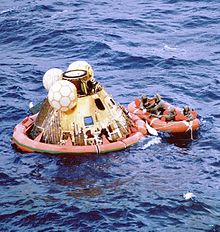
Those three men came home — Neil Armstrong, Edwin “Buzz” Aldrin, and Michael Collins.  My father and I watched the splashdown on our black-and-white television.  I still find it amazing that three astronauts who had been to the moon would end their journey with the NASA equivalent of water wings.

After Apollo 11, five more missions went to the moon.  The last was Apollo 17 in December 1972.  It was that mission that gave us the famous picture of the earth from the moon known as “The Blue Marble.”

Our planet looks serene and cool from the perspective of the moon.  The red hot flames of war are not seen, only the swirl of clouds, the vast blue of the oceans, and the outline of the continents.  But, since Vietnam, we have been in war more than we’ve been out of it, it seems.  I guess we know which decision America made.

But it also says something about us that the “Blue Marble” picture has been reprinted so many times and is now so familiar to so many.  I think it’s how we want to see our world, a place where war and national boundaries and economies and strife are too small to be seen with the naked eye and too insignificant to matter in the big picture.