Duck, Duck, Duck, Zen

My good friend and sherpa-guru, Denise, recently reminded me of the spiral quality of the spiritual path.  The idea is that the journey is not a straight line or even a chaotic one; it’s a purposeful and patterned returning and returning and returning to constant themes throughout our lives, each time seeing them from a higher place.

This might show up in our emotional work in this way: We visit a therapist in our 20’s to work through a particular emotional pain.  We journal and scream and talk and cry it all out until we feel a release.  It’s gone!  We’re light and happy and free.  Life is beautiful.  Until a year later when the same old shit pops up again.  It might seem we wasted all of that time, energy, and money.  But if we’re really aware, we recognize that we’re seeing the old pain from a slightly different perspective.  We’re a floor up in our spirit, but we’ve circled back around to the same side of the building.

The spiritual journey follows a similar stairway to heaven, and I’ve gone round and round.  I’ve learned to recognize different levels (“fifth floor: ladies lingerie, peace of mind”).  An early level is one I call:

Practice-Practice-Practice-Forget About It

Actually, there are at least two preceding levels: Practice-Forget-Forget-Forget, and Practice-Forget-Practice-Forget.  But, we can talk about all three together.

The practice is our spiritual work.  It looks different for each of us.  My practice is meditation, yoga, engagement with my spiritual community, reading, walks in nature, and general mindfulness.  Some people practice with prayer, church/synagogue/temple, playing tic-tac-toe.  Literally ANYTHING can be part of a practice if you have imbued it with that energy.

Early on the journey, I had really great intentions.  (Pause for delayed laughter.) I knew what called to me, but I hadn’t quite found the groove.  I worked at it.  Boy, did I work at it.  And I would forget it, sometimes for weeks, sometimes for months, and at least a time or two for years.  It took getting beyond those levels to really see how important the forget-about-it times were.  Those were the incubation periods.

Then came the next level:

Practice-Practice-Practice-Wander In The Wilderness

Until we completely purge our inner victim, we’re destined to periodically wail into the heavens, “My God, My God, why has thou forsaken me?” This is done with a flourish of great drama.  This is the level on which we find ourselves saying things like “But I’ve been doing my work; really I have.  Why does God let this HAPPEN?” (Wail, moan, general gnashing of teeth.)

This, too, is an important time.  I believe Jesus may have been on this spiral when he spent his 40 days in the desert.  It’s the level where we wrestle with angels . . . and devils.  At times, we threaten to scrap it all and live our entire lives in happy hour at the beach.  We are tempted to buy happiness by giving up the hope of joy.

The most important moments of transformation happen here.  We make a decision: keep climbing or jump over the rail.  What we don’t realize is that jumping over the rail only puts us back into a forget-about-it state.  We WILL be back.  We can’t un-know what has been revealed to us.

Eventually we reach a new landing:

Practice-Practice-Practice-Practice

We’ve achieved consistency.  We walk our talk.  Life still presents challenges, but these are much rarer, and we tend to view them from a place of detachment.  This doesn’t mean we don’t care; in fact, we have learned compassion at levels we’ve never known before.  We just don’t internalize pain so readily.

This is a beautiful level.  It can also be exhausting.  The practice brings peace, but in those 3:00 a.m. moments when no one is watching and we’ve dared to be really honest with ourselves, we still sometimes wonder, “What’s the point?  IS there a point?  Is something supposed to HAPPEN? Is this IT?”

And then magic happens.  It happens because of our practice.  It happens in spite of our practice.  It happens most often in those 3:00 a.m. moments of heart-opening honesty.

The magic doesn’t have a level.  It dances around the spiral like pixie-dust and star stuff.  It waits until we’re ready.  And then it teaches us the next step:

Practice-Practice-Practice-Surrender

Every great religion teaches it.  Every great master has done it.  Every enlightened being lives it.

How do we know God?  How do we align with Divine Mind?  How do we step into the One-Ness?  We. Stop. Practicing.  At least for a moment.  We stop everything.  We release.  We let go.

We surrender.

Much like the early levels, I’m sure there are some additional levels here, and perhaps the place of true bliss is one of surrender-surrender-surrender-surrender.

Maybe there is even something after that.  I’ll let you know.  I’m still climbing.

Everybody Needs A Buddy

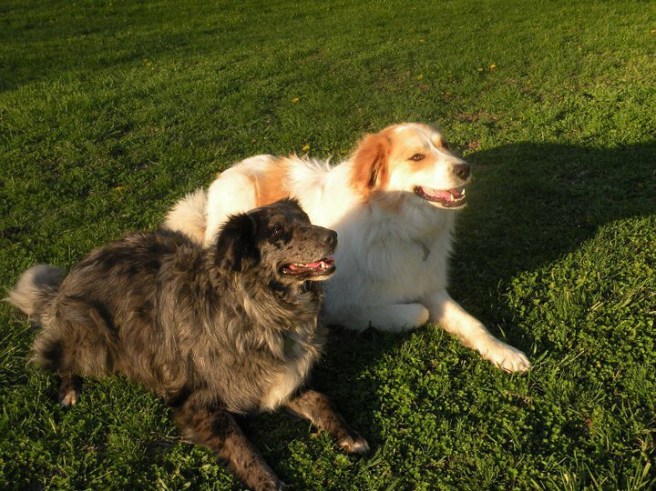
A year and a half ago I had to make one of the toughest decisions of my life (not an overstatement).  Because of various and sundry life changes that I won’t detail here, I had to make one huge domino fall in order for the others to follow suit.  I had to re-home my two beloved dogs, Sebastian and Pepper.  It broke my heart then, and it breaks my heart still.  But a combined 140 pounds of dog wasn’t conducive to apartment living.  It would not have been easy for me, and it would not have been fair to them.

img_1165

A lightning-strike solution presented itself with ease and grace, and I believe that their move to a new home (complete with huge backyard and a loving person) was directed by the universe.  But, damn, the loss.  The horrendous, endless sense of loss.  And because it was ultimately a decision, the questioning.  The horrendous, endless questioning.

I’ve been thinking a lot about loss lately.  I think a lot of people do during the holidays.  The older I get, the more loss I have experienced, of course.  There is an invisible line I crossed which no one told me about where the brain is more occupied with memories than with planning.  And memories are the currency of loss.

Memories and 70’s music.  When I’m feeling all the feels, I tend to run toward them for a warm embrace rather than trying to avoid them.  So today I’ve been basking in the feeling of loss while listening to Carole King (“You’re So Far Away”), Elton John (“This is Your Song”), John Denver (“Rocky Mountain High”), and James Taylor (just about any song).  The music of that era seems to have been centered around chords and chord progressions that evoke loss — it’s that sweet, happy-sad sound that gives a sense of meaning even to lyrics like “I want to make it with you.”

Memories are the savings account of emotion.  Sometimes they bring a deep and indescribable pain, but they are the evidence of a life well lived.  For me, they hold my dad, my grandparents, old loves, college memories, moments — those moments that would seem insignificant to anyone else but which hold deep meaning for me.   Those people who meant something to me, and even I can’t explain it.  Facebook friends I never actually met who died, and their death ripped a hole right through me.  Celebrities, yes, celebrities whose passing feels like a loss for the planet.  That person I haven’t seen in 30 years who still shows up in my thoughts now and then.

New Year’s Eve is a natural time for taking this journey into yesterday with all its joys and sorrows.  With all its loss.

I am learning to reframe loss in three significant ways.

First, I am choosing gratitude in place of grief.  I miss my father so deeply some days that it feels like I can’t breathe.  But, I have found that I can shift the feeling from devastation to appreciation if I stop and say, “I’m so grateful you were my dad.”

Second, I am only giving yesterday a limited amount of emotional space.  I’m grateful for my memories, but when they start to dominate my internal conversation, I consciously focus on tomorrow and plans and hopes and dreams and possibilities.

Third, I just look at Buddy.  My pup is, without a doubt, the best decision I made in 2016.  That, too, is not an overstatement.  I’ve had lots of animals in my life, but I’m not sure any being has brought me so much joy. Babies always win over loss.

img_1131

Actually, there is a fourth thing I do — I change the Pandora station.  Carole King is good for purging, but Abba is good for happy.

“You are the dancing queen, young and sweet, only seventeen . . .”

How an Election Set us Free

I’ve spent a considerable amount of time wondering why Donald Trump is the President-Elect of the United States.  This is not the kind of “why” that is actually asking “how.”  I’m not contemplating what did or didn’t get said by the Trump Camp or the Clinton Camp to Rust Belt workers or West Virginia coal miners or disillusioned Bernie-or-Busters.

No, this is a true why.  If every development in life has meaning (and I believe it does), then what is the meaning here?  If every event has purpose (and I believe it does), then what is the purpose now?  In other words, why?

I believe there are probably scads of answers to the why, maybe one for each of us.  I may have landed on one that works for me, though.

There is a concept called “American Exceptionalism.”  It is the belief that America’s history (including her world-changing Revolution) and democracy (which the rest of the world needs, of course) place this nation in a superior position.  It is the belief that the United States is truly exceptional, truly better than the rest of the world.  This belief is so widely held in political circles that President Obama was “accused” by Louisiana Governor Bobby Jindal of not adhering to it, a claim that might be considered “fightin’ words” to many on Capitol Hill.

This sense of American Exceptionalism oozes from the pores of our society.  We see it in the cocky strut of an NFL player scoring a touchdown.  We hear it in the chants of “USA! USA! USA!” at the Olympics.  Any teacher can vouch for the unearned level of confidence displayed by a student population that ranks unremarkably in the middle of the worldwide pack in science and math.

The truth is we’re not exceptional.  This is especially true for those, like me, who believe in the unity and equality of all humanity.  Yes, we had a remarkable Revolution and established an early model of modern democracy.  I know how profound all of that was; I teach it on a fairly regular basis.  But we didn’t invent democracy, the Greeks did.  And we didn’t win a revolution on our own; the French helped considerably, as did others.  And in the midst of lofty ideas of civil liberties were the more base motivators of taxes, trade, and economy.

No, we’re not exceptional.  We’re another link in a long chain of human evolution.  We have some truly admirable qualities; we also have many that are not.

In 1630, John Winthrop preached a sermon to Puritans on board the Arbella.  The sermon was called “A Model of Christian Charity,” and in it he referred to the society they would form in the New World as “a city upon a hill.”  The phrase comes from Jesus’ Sermon on the Mount, but since Winthrop, it has been synonymous with first the colonies and then the nation.  The concept maintains that this “city upon a hill” is a model for the world.   It was not merely a 17th century idea.  John F. Kennedy, Ronald Reagan, George H.W. Bush, and, yes, Barack Obama all made references to it during various speeches.

And that brings us back to Donald Trump.  During the 2016 Presidential Campaign, Mitt Romney made this statement about Trump:  “His domestic policies would lead to recession; his foreign policies would make America and the world less safe.  He has neither the temperament nor the judgement to be president, and his personal qualities would mean that America would cease to be a shining city on a hill.”

And there’s my why.  We’ve thought we were hot shit quite long enough.  We’re not.  We sometimes make terrible mistakes.  If we can manage some humility, we might learn something through this.  At the very least, we can finally put down that heavy mantle of greatness we’ve lugged around for so long.

Let’s Ask the Atheist to Say Grace

IMG_0573.PNG

In First Thessalonians, the Christian New Testament tells us to give thanks in everything.  The Psalmist of the Old Testament bathed in gratitude.  The Quran tells us that “any who is grateful does so to the profit of his own soul.”  The Buddha taught gratitude as the response to both a kindness and a slight knowing that both contain lessons, the latter often more so than the former.  Hindu practice hinges on living from a place of constant gratitude.  Countless examples of Native American literature emphasize again and again the practice of gratitude to the Great Spirit.

I could go on, but I believe my point is made.  Spirituality, religious identity, holiness — whatever you want to call it — exists in gratitude, regardless of which brand name you prefer.  Thankfulness is perhaps the most consistent element in the history of religious thought.

But, what about those pesky atheists?  Can they even DO Thanksgiving?

I’ve heard people ask that question before.  The assumption underlying this question is that gratitude requires a celestial being as the source of all giving to whom one expresses thanks.

I read a story this past week that came from Hasidic teachings which I will (grossly) paraphrase here.

The student asks the teacher, “Teacher, why did God create atheists?”

The teacher replies, “To teach us compassion.  When an atheist sees a person in need and responds to that need, he does so not to win favor with his God, but simply to act compassionately.  Whenever you see someone in need, you should become an atheist.  Act from a heart of pure compassion and remove any possibility that you are acting out of a selfish need.”

Perhaps also in Thanksgiving we should be atheists.  Rather than thanking whatever your version of God might be — man on a cloud or ethereal energy — perhaps consider who actually provided that for which you feel grateful.  Thank the farmers who raised the turkey and threshed the wheat and bogged the cranberries.  Thank the factory worker who assembled the car you drove over the river and through the woods.  Thank the furniture maker who built the couch you can potato on all afternoon watching football.  Thank the football players who gave up their holiday for your bash-’em-up pleasure.

Thank the breeder who raised the puppy who “helps” you cook.

Now, it just so happens that I believe there is a Source in the universe (though I lean  more toward ethereal energy than man on a cloud).  I have no problem thanking that Source for everything in my life.  Here’s the thing though — when I thank the farmer and the factory worker and the football player, I feel gratitude to both the conduit and the source at the same time.  If I just thank the source, well, I sorta’ skip the middle man.

We are the brokers through which Divine goodness flows from source to other people.  We show up as God in each other’s lives all the time.  I have to believe that being grateful to each other pleases God, however you see her.

So when the big feast starts, bow your head and give thanks, if that’s your preference.  Just don’t forget to kiss the cook as well.  And, always, ALWAYS, ask the atheist to say grace.  You know, just for shits and giggles.