Deciding on The Decider

High office teaches decision making, not substance. It consumes intellectual capital; it does not create it. Most high officials leave office with the perceptions and insights with which they entered; they learn how to make decisions but not what decisions to make.  — Henry A. Kissinger

I have a love/hate relationship with politics.  It’s like a drug I can successfully abstain from for awhile, and then suddenly it’s as if I’ve gone to a party where everyone is passing around the pipe.  I hesitate (almost imperceptibly) and then say, “What the hell.”

And now the silly season is looming over us yet again.  I opened my Comcast home page to be met with the news that Sarah Palin thinks she could beat President Obama.
In checkers, maybe.  She promises to make an announcement in August or September.  I can hardly wait.  (Please, do it, Sarah.)

See?  I’m pulled in yet again.  If personal history is the least bit accurate, I will slide down the long and slippery slope of political interest until splashing into the pool of election frenzy about 16 months from now.

I’ll let you in on a little secret.  There was one thing I actually admired about George W. Bush (and, yes, a small puff of smoke arose from my keyboard as I wrote that sentence).  I actually appreciated the fact that he was “the decider.”

A friend of mine always says, “Let’s do something, even if it’s wrong.”  I thought of that saying often during the Bush II Era.  I rarely liked his decisions, but I had to give him credit for simply making them.  Washington has such an incredible tendency to become a stagnant cesspool of indecision that it isn’t really that difficult for a confident “decider” to rise above the crowd.

Because that’s really what we are voting for on election day — a decision maker.  Our entire democratic republic is based on that concept.  With rare exceptions in the form of ballot initiatives, we rarely vote for ideas; we vote for people.  We don’t make decisions; we vote for decision makers.  And then we hold our breath for the next four years as we watch them do exactly what we gave them the power to do.

President Obama’s ability to hold the Republican hopefuls at bay in 2012 may well depend solely on his ability to appear decisive.  Americans have their pet issues and political perspectives, but mostly they just want to know someone is in charge.  Someone who is not afraid to make a decision.

I contend that the President’s 2012 hopes will rise and fall not so much with the decisions he makes, but with his ability to appear decisive as he makes them.  That theory, of course, is dependent upon the assumption that the decisions won’t be too outlandish.  I suppose if he decided to invade France, I would have to return my Amateur Political Scientist merit badge.
In Your Facebook


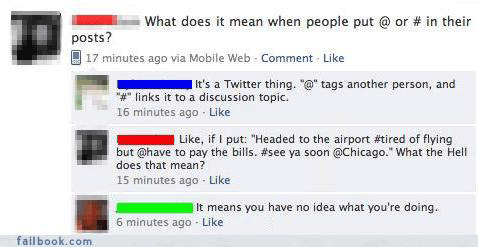
IMPORTANT ANNOUNCEMENT FOR ALL FACEBOOK FRIENDS, ACQUAINTANCES, AND THAT ONE PERSON I SUPPOSEDLY WENT TO COLLEGE WITH WHO I SWEAR TO GOD I’VE NEVER MET:

I will not repost your status update for an hour.  In fact, I have never posted a status update and then set an alarm so I could change it after a specific time.  I’m so very sorry if you or someone you love has an illness or if you are deeply concerned about the plight of dolphins or if you believe that Caylee Anthony should have a law named after her.  I will not respond to peer pressure regarding what I should or should not care about.

If you want to cure cancer or stop global warming or end child abuse, then three cheers for you.  I would love to see all of those things happen as well.   Feel free to express your concern for these issues in any way you like.  Just don’t throw down a Facebook gauntlet.  I will not take your online litmus test of compassion.  If you post something interesting and I am compelled to do so, I will share it.  But, I will almost CERTAINLY not do so if you ask me to, and there is NO DOUBT that I will not do so if you “dare” me to.

And while I’m at it, is it really that important for you to know how many Christians, proud Americans, or lion tamers there are on Facebook?  Is it really that important for you to identify with a group and receive some kind of validation from its size?

Please, PLEASE, start playing Farmville again, and leave the social advocacy to those who can think for themselves.

By the Power Vested in Me by the State of New York . . .

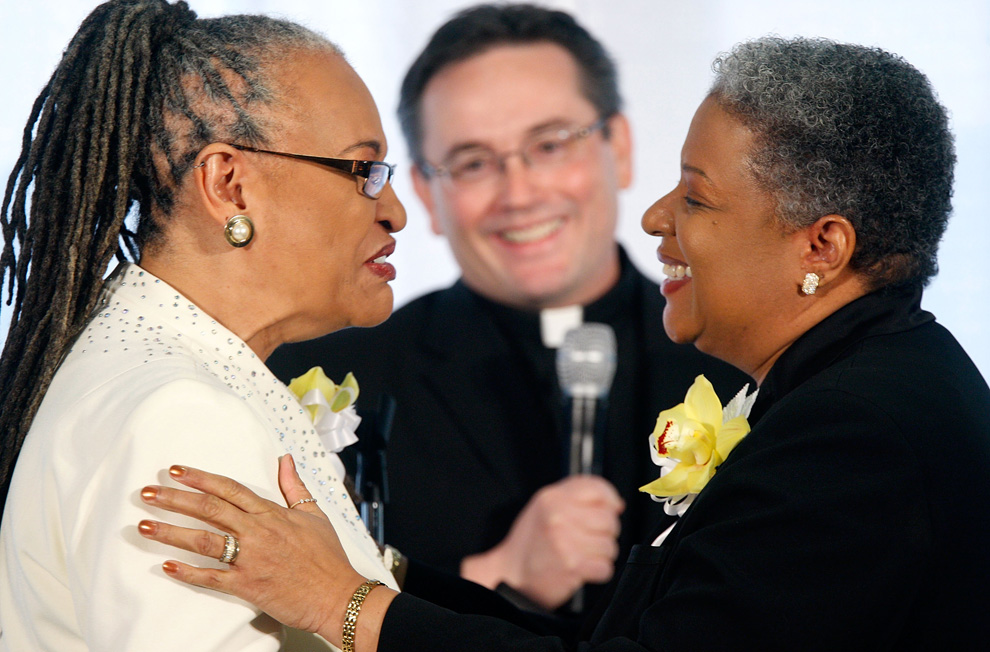
“‘We always treat our homosexual brothers and sisters with respect, dignity and love. But we just as strongly affirm that marriage is the joining of one man and one woman,’ the state’s Catholic Conference said in a statement.”   (From the Yahoo News story entitled “New York Governor Signs Law Approving Gay Marriage, 06/25/2011)

Can respect, dignity, and love be conditional?  The Catholic Church seems to think so.  And lest my Catholic friends think I’m picking on them, so does the Baptist church, the Mormon church, the Nazarene church, the Church of Christ, et. al.

But freedom of religion protects the rights of churches to be bigoted, judgmental, and small-minded.  I defend their right to believe they are morally superior to me.  (Just because they believe it, doesn’t make it so.)  But, I feel it fair to warn them that their contradictions are showing.  When you speak out of both sides of your mouth, people will eventually see your duplicity.  If the churches aren’t careful, their reputations will start to equal that of politicians or those poor abused used car salesmen.

Churches used to say what they really believed (some still do).  They used to say that gays and lesbians were going to hell.  They used to say that gays and lesbians were not allowed to be church members.  They used to liberally throw around the word “abomination” in reference to their “homosexual brothers and sisters.”  But slowly the social sand shifted and that position became seen as judgmental and unloving, especially by the younger generation.  The churches began to realize they turned more people away than they attracted by being antigay hardliners.  So they did what any political organization would do: they changed their message.

Now, lest you misunderstand me, the message from the Catholic church at the top of the page is an immense improvement over the casting-into-a-lake-of-fire messages of yore.  But the problem with trying to balance in the middle is that the attempt to appeal to both ends of the spectrum is transparent.   As a general rule, this gets little attention.  Churches have been carefully crafting their stances for maximum impact for years.

I won’t get into the definition-of-marriage argument, the marriage-is-a-civil-institution argument, or the Solomon-had-300-wives-and-700-concubines argument.  Those have been done, and you can find them for yourselves.  The simple fact remains that if you claim to respect, dignify, and love another then you must not use your religious position to minimize that person’s equal standing in society.  As many times as the church has done that already, against Native American Indians, African-Americans, and anyone else they had an interest in keeping subordinate, you’d think we would recognize the pattern.

Oh, well.  Catholic church or no Catholic church, marriage equality exists in New York today.  Three cheers for the rule of law.

Gaia’s Got Her Blinker On

One of the reasons I like measuring my days by the milestones of the ancients (also known as the milestones provided by the universe) is that they are both simple and complex.  The solstice itself is a rather simple event.  The word is often used to refer to the entire day on which it happens, but the actual solstice takes place in an instant.  This year, that instant will take place at 12:16 p.m. (CST), on June 21.

At one specific blip sometime during that minute, the sun will beam directly on the Tropic of Cancer and strike the northern hemisphere of the earth with its most direct rays.  In that nanosecond, summer will begin.  On the top half of the globe, the sun will shine longer than it will any other day of the year.

Piece of cake.  Long day.  Summer begins.  Tropic of Cancer.  We learned all of that in eighth grade biology.  But what we didn’t learn in eighth grade is usually so much more profound than what we did.  As I’ve watched the solstice pass each year (don’t blink! you’ll miss it!), I’ve incorporated new shades of the meaning it has to offer.  The mystical earth and the magical heavens can be our teachers if we let them.

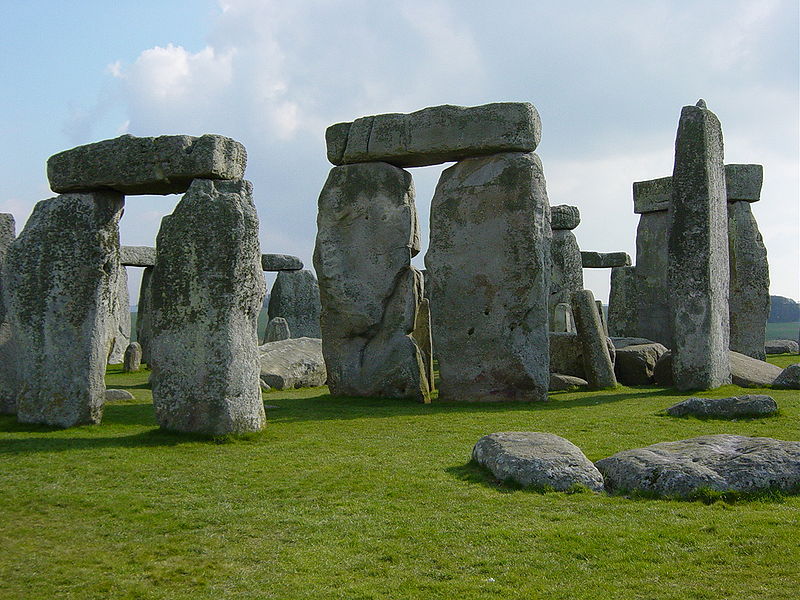
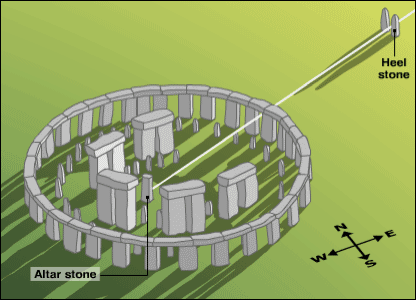
The ancients devised ways to capture this blip of time that passes only once every 365 days.  They built monuments to it.  They conducted ceremonies for it.  Most likely, they built bonfires and danced naked in acknowledgement of this great mystery they might not have fully understood but fully accepted.  They might not have been able to launch a space shuttle, but they knew that from this moment each day would shorten just  a smidgeon.

I looked up the word “solstice” in the dictionary tonight not expecting to find anything new.  Whenever I do that, I always find something new.  The second definition read, “a furthest or culminating point; a turning point.

The solstice isn’t really about the instant of the solstice at all.  It’s about the turn.  It’s about a shift in direction.  It’s about endings and beginnings.  It’s about celebrating transformation.

It’s that simple.  And it only took me a decade or so to see it.