Write It Down

In my World Literature class, we spend some time studying biblical literature, as well as literature that predates the Judeo-Christian bible.  I explain to my students that the ancient Hebrews weren’t really all that impressive.  They were a wandering group of shepherds who only produced two great kings — David and Solomon.  They didn’t create great urban centers along the known world’s great rivers.  They didn’t develop an alphabet or contribute medical, architectural, or economic developments to humanity’s knowledge base.

There were far more complex societies such as the Akkadians, Sumerians, and Egyptians which left their mark on the ancient world.  In short, the Hebrews didn’t do much of anything, except . . . they wrote their story.

 As I was going through old boxes of pictures, cards, and letters yesterday, I ran across the beginning chapters of my father’s autobiography which he had mailed to me in 1999.  It was mostly random memories of his early childhood and teen years, but chock full of long-past moments now fascinating to me.  His homerun record in Little League.  The first family vacation to Florida.  Driving himself to get a haircut when he was ten (with his father’s permission to take the car).

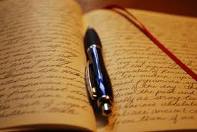
I also have some journals of sorts that had belonged to my maternal grandfather.  I say “journals of sorts” because grandpa was far too busy to spend much time in a writer’s necessary pondering.  He kept pocket-sized datebooks in which he would record events.  When he died, my mother gave each of us the book from the year we were born.  On April 5, 1964, grandpa wrote, “Debbie born.”  That’s it.  Just those two words.  Yet, when I read them, in his handwriting, I can imagine him pulling out his datebook after receiving the call and making a notation of the fact that I had arrived.  By writing those two words, he put a pushpin into the map of time, a reference point that somehow validates that I was here.

I love blogging, but there is something precious about my personal journal.  It tells my story in a much more intimate way.  It explores my relationships and personal process in ways that I may not always feel comfortable making public.  I love writing a secret to the universe and wondering what will happen to those secrets.  Will someone read them one day?  Will a niece or nephew discover them when I have passed from this earth?  Will a stranger, picking through the garbage after the estate sale, pick up a plain brown-covered book I hunched over years before and find it interesting or even perhaps instructional?

Write your story.  In whatever way you desire.  Whether it is a two-word comment in a tiny date book or an epic narrative.  I can’t promise you’ll influence the world in the way Moses has, but you just might leave your children the most precious part of you, memories you know so well but which will be a secret kept from them forever if you don’t write them down.

Shhhh! Don’t Tell Anyone

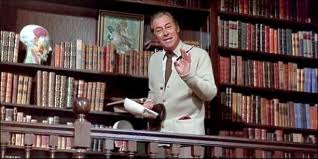
I’ll let you in on a little secret.  For years I’ve had this dream of opening a “place.”  I put that in quotes because I’m not quite sure what to call it.  It would look a whole lot like the picture above.  Part bookstore, part coffee shop, part modern version of a literary salon.  I even toyed with a name: Gertrude’s, after that famous salon keeper herself, Gertrude Stein.

And maps.  There would have to be maps because I am a long-time cartophile.  I can stare at a map for hours, read it almost like a book.

Maps and books and coffee and tea and lots of discussion.  The barista would be more of a bartender.  There would, in fact, be a coffee bar where one could sit and sip and bend the ear of the very well-educated barista.

A back room.  There would have to be a back room for poetry slams and writers’ groups and book clubs.

With the announcement today that Borders was officially closing all its stores, there were simultaneous and breathless hopes expressed on NPR that perhaps this might give some breathing room for a slight resurgence of small, independent bookstores to flourish.  A significant portion of the population still wants to smell books and touch them and walk among them.  Many of us are still romantically attached to that dream of having a library like Henry Higgins’.

I’m not sure I’ll ever realize this dream.  That’s okay.  I have plenty more where that one came from, and I was never quite sure I could fully commit to the endless hours required in owning a “place” such as this.  But, I still believe that in the right place and the right time and with the right energy, it could be a wonderful place for geeks to meet.

Oh.  And a liquor license.  Definitely a liquor license.

Remembering Apollo 11

I remember the first time I became aware of the larger world.  I was five, and until that point everything that mattered was contained in my family.  My universe consisted of our house, a few adjoining backyards, our church (always the damn church), and that satellite known as “grandma’s house.”  I was blissfully ignorant of almost everything that engages the attention of everyone else on the planet.

Then something happened that took me out of my personal solar system.  I learned about it when my father came home that July afternoon.  I was playing on the front steps, and he pulled into our driveway in his baby blue Plymouth Duster.  He seemed to almost hop as he came around the car, strode the sidewalk briskly toward me, and then swooped down to pick me up.  He didn’t just bring me chest high to hug me.  Instead, he lifted me straight up in the air as high as his arms could reach.

“Baby,” he said, his excitement evident and barely contained.  “Today a man walked on the moon.”

My father wasn’t the only one excited.  This event captured the imagination of the world.  It was a restless time on this planet with the Vietnam War erupting abroad and disgruntled people finding their voices at home.  All of that seemed to stop as the world breathlessly awaited those assuring words, “Houston, Tranquility Base here.  The Eagle has landed.”  It was July 20, 1969, and the jury was still out on whether humanity would choose the way of war or the way of peaceful exploration as the foundation for our collective future.

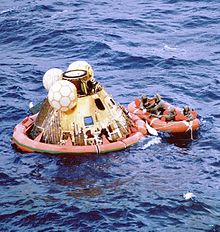
Those three men came home — Neil Armstrong, Edwin “Buzz” Aldrin, and Michael Collins.  My father and I watched the splashdown on our black-and-white television.  I still find it amazing that three astronauts who had been to the moon would end their journey with the NASA equivalent of water wings.

After Apollo 11, five more missions went to the moon.  The last was Apollo 17 in December 1972.  It was that mission that gave us the famous picture of the earth from the moon known as “The Blue Marble.”

Our planet looks serene and cool from the perspective of the moon.  The red hot flames of war are not seen, only the swirl of clouds, the vast blue of the oceans, and the outline of the continents.  But, since Vietnam, we have been in war more than we’ve been out of it, it seems.  I guess we know which decision America made.

But it also says something about us that the “Blue Marble” picture has been reprinted so many times and is now so familiar to so many.  I think it’s how we want to see our world, a place where war and national boundaries and economies and strife are too small to be seen with the naked eye and too insignificant to matter in the big picture.

Deciding on The Decider

High office teaches decision making, not substance. It consumes intellectual capital; it does not create it. Most high officials leave office with the perceptions and insights with which they entered; they learn how to make decisions but not what decisions to make.  — Henry A. Kissinger

I have a love/hate relationship with politics.  It’s like a drug I can successfully abstain from for awhile, and then suddenly it’s as if I’ve gone to a party where everyone is passing around the pipe.  I hesitate (almost imperceptibly) and then say, “What the hell.”

And now the silly season is looming over us yet again.  I opened my Comcast home page to be met with the news that Sarah Palin thinks she could beat President Obama.
In checkers, maybe.  She promises to make an announcement in August or September.  I can hardly wait.  (Please, do it, Sarah.)

See?  I’m pulled in yet again.  If personal history is the least bit accurate, I will slide down the long and slippery slope of political interest until splashing into the pool of election frenzy about 16 months from now.

I’ll let you in on a little secret.  There was one thing I actually admired about George W. Bush (and, yes, a small puff of smoke arose from my keyboard as I wrote that sentence).  I actually appreciated the fact that he was “the decider.”

A friend of mine always says, “Let’s do something, even if it’s wrong.”  I thought of that saying often during the Bush II Era.  I rarely liked his decisions, but I had to give him credit for simply making them.  Washington has such an incredible tendency to become a stagnant cesspool of indecision that it isn’t really that difficult for a confident “decider” to rise above the crowd.

Because that’s really what we are voting for on election day — a decision maker.  Our entire democratic republic is based on that concept.  With rare exceptions in the form of ballot initiatives, we rarely vote for ideas; we vote for people.  We don’t make decisions; we vote for decision makers.  And then we hold our breath for the next four years as we watch them do exactly what we gave them the power to do.

President Obama’s ability to hold the Republican hopefuls at bay in 2012 may well depend solely on his ability to appear decisive.  Americans have their pet issues and political perspectives, but mostly they just want to know someone is in charge.  Someone who is not afraid to make a decision.

I contend that the President’s 2012 hopes will rise and fall not so much with the decisions he makes, but with his ability to appear decisive as he makes them.  That theory, of course, is dependent upon the assumption that the decisions won’t be too outlandish.  I suppose if he decided to invade France, I would have to return my Amateur Political Scientist merit badge.