The Whole Self

Over the past few months, I’ve dropped some weight — about 30 pounds now from my highest point. And 30 pounds is a lot. For perspective, a jug of milk weighs about 8.6 pounds. So if you could pick up approximately three-and-a-half gallons of milk, that’s how much weight I’ve lost. My knees and my heart and my belt all are quite happy about this.

So is my spirit.

Now, let’s get one thing clear right from the start. This isn’t some kind of body-shaming, finger-wagging, skinny=sacred kind of post. We don’t play that. This is about Deb.

And it’s about that diagram above. Notice that the triquetra isn’t divided into body-mind-spirit as is usually done. Instead, the human triad is body-mind-emotions, and all of that is contained within the spirit — our sacred essence that is, ultimately, the I AM that I AM and YOU ARE.

Our Sacred Self is unchanging. It wasn’t born and will not die. It is Infinite Joy, Boundless Love, Perfect Peace. So how could a few pounds here or there have any impact?

We pay attention to our physical, emotional, and mental health not because the Spirit suffers if we don’t, but because our ability to clearly connect with our higher Self can be inhibited. We remove layers of distraction, layers of attachments so we may become awake to and aware of our true Self.

This is why yoga includes asanas, the postures that are merely a part and that many in the West believe are the whole of yoga. If you’ve ever wiggled and squirmed through meditation because your body felt uncomfortable, it may be because you didn’t stretch and prepare the body for its role in attaining sacred stillness.

My weight loss began slowly and wasn’t initially connected to this understanding. As the months passed, I added a daily yoga practice to my newly focused attention on what I ate. Despite my Aries tendency to DO ALL THE THINGS RIGHT NOW, I discovered that ten minutes a day, every day, is better than an hour once a week which soon is dreaded and eventually falls by the wayside. My ten-minute asana practice is followed by a five-minute silent meditation. Just five minutes. (Note: I meditate at other times of the day and sometimes for longer, but that’s of no importance — five minutes is fine.)

My body has become an important part of my spiritual practice. I am responding to it as it needs and in the best way I can for me. I take care of it so that when I need it to be still, it listens. Your response to your body may look completely different. In fact, I would say it absolutely should. But I encourage you to start somewhere. Start small. Really small. Small and big are irrelevant to Spirit.

Remember that the most important part, the only part that matters, in fact, is the Oneness with Divine Presence. Anything that serves this alignment is a sacred practice.

Even calorie counting.
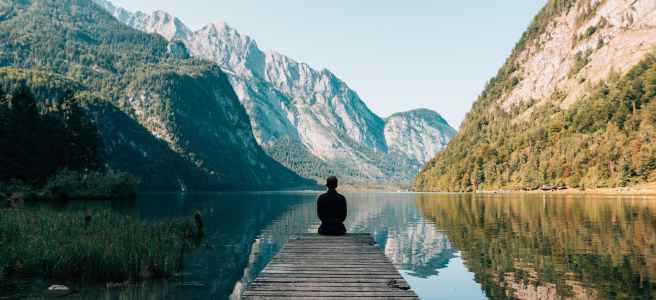
Who Are You?

I don’t mean the famous question from the band The Who, the one that sounds like it’s being answered by an owl.  I really want to know . . . who are you? 

When we’re faced with that question, we often begin with our labels.  I’m a teacher. I’m a musician. I’m an artist. I’m an insurance agent. I’m a carpenter. Even our name is really just a label. 

But do those labels answer the question? Who are you? Really? If you stop being a teacher, you don’t stop being.  If you stop being a carpenter, you still exist. You could abandon even your name and still be. 

Those labels are like nesting dolls, those Russian wooden dolls that, when pulled apart, reveal a slightly smaller version of the same doll, which can be pulled apart revealing another slightly smaller doll, and so on. In the same kind of way, we add layer and layer of identity until we forget who we really are and begin to identify with the shells.  

According to many great spiritual teachers, who you are is none of the things that you might use to uniquely define yourself. Those specific parts of your personality, your talents, your intelligence, your sense of humor, might be how you express yourself in the world, but they are not the essence of you.

Our lives begin as a purity of essence that quickly gets covered up. Our parents give us a name. They begin immediately to tell us who we are.  “You’re so pretty.” “Oh, what big eyes.” “Such a sweet smile!” We first know ourselves as seen through the eyes of our caregivers. They are our first mirrors. As we grow, we take on more identifying features. We get them from family and friends and teachers and television and bullies and . . . ourselves until we have completely covered that essence.  Many of us eventually reach a moment when we decide we want to know who we really are deep down inside. This is often initiated by crisis, a dark night of the soul, a collapse of our ego’s scaffolding. 

Advaita Vedanta is the school of Hinduism that focuses on non-duality. It holds that pure consciousness, what Hindus call “Brahman,” is the only reality.  That single reality, that non-dual reality, is unified Divine energy that is the life force in all creation.  There is no dual you and I or I and God. There is only one life. It is nature. It is Divine. It is you. It is me. 

Advaita Vedanta teaches that we are made up of five layers, called koshas. Kosha literally means “sheath,” or you could think of it as a cloak. Like nesting dolls, we wear these cloaks over our Divine Essence.  The first cloak is the physical body.  It is the dense material cloak. The second kosha or cloak is the energy body. This is the layer where the chakras and the divine meridians are located. The third cloak is the mental and emotional layer. The fourth is the wisdom layer. The fifth is the layer of bliss. Vedanta yoga often ends there, though some teachers add the sixth layer, and this layer is referred to as the True Self.

Uncovering this essence, our true self, is our spiritual work.  We are not in search of something because we already are that which we think we’re searching for. 

Who are you? You are pure love, pure peace, pure Divine Presence. You are this pure essence even when you can’t see it for all the layers covering it. You are the you are. I am the I am. 

The Marigolds

Brick wall whitewashed to look 
new old. Worn floors refinished, 
wood polished, shining. Mats 
a safe six feet apart in this, our 
first class in the yoga studio 
since being forced into solitary 
practice seven weeks ago. 
Faint acoustic music from the 
Bluetooth. Benign renditions of a 
change to come and my sweet
lord. Diffused patchouli mist 
tussles with the alcohol in 
homemade hand sanitizer. 
The instructor tells us when 
to breathe.

I was in India when the pandemic
took over the world.  One day
Holi, slapping powdered color on
friends and strangers alike, rubbing
it into their hair, more intimate in the
playfulness than we would be
otherwise. Bollywood bass lines 
thumping the speakers. Colors running
in rivers of sweat. The next day, 
weighing options. Can we get back 
into the States? I don’t want to
leave a thousand kindnesses. The 
drumming of the Shiva temple in the 
morning.  An entire nation of 
incense and marigolds.  Breathing, 
rhythmic, human yoga.  

Inhale, she says, arms above 
your head. Exhale, fall into forward 
bend, and we comply, an army 
of six following field commands in 
unison.  The tips of my fingers 
feel the hardness of the thin-matted 
floor.  In the position’s hold I 
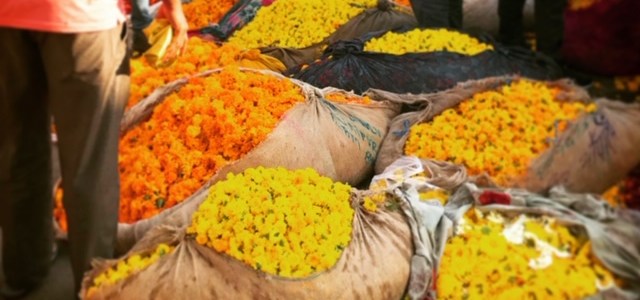
think of the flower market in Jaipur, 
mounds of marigolds, like walking 
through the clouds of a Hindu heaven, 
fighting the urge to jump into one, 
the petals cushioning 
the fall.

© 2020 Deb Moore,  All Rights Reserved