One Thing I Learned in Sunday School

A few weeks ago, a friend of mine and I were having a chat when she asked me a question I had some difficulty answering.  We were discussing race relations/equality/justice and so forth, all issues about which I am infinitely passionate.  My friend asked, “Where did you get your intense devotion to issues of racial equality?”

Hmmm. . . where did I get it?  I can think of oodles of examples that nurtured it along the way, but the initial springboard seemed a bit of a mystery.

My friend asked, “Did you come from a liberal family that cared deeply about social justice?”

After L-ing a bit too OL (thanks for the line, Modern Family writers), I said, “No, that would not have been it.”  My family was about as equality minded as any other conservative white family in the 60s and 70s.

“Do you think it has something to do with being a lesbian?  You know, your own experiences with inequality naturally transferring to other minority experiences?”

I think that certainly has an impact on my ability to understand the pain of being on the shorter end of the “equality” stick, but still not the source.

I pondered this question further on my own over the next few weeks.  I wondered if, in the words of the sage philosopher Lady Gaga, I was simply “born this way?”  I’m sad to say that probably wasn’t the case either.    So, what was it?  Could I go back and discover the seed?  I pondered this question in depth, as I am wont to do with just about any single thing one can imagine.

Then I thought of Mrs. Soper.

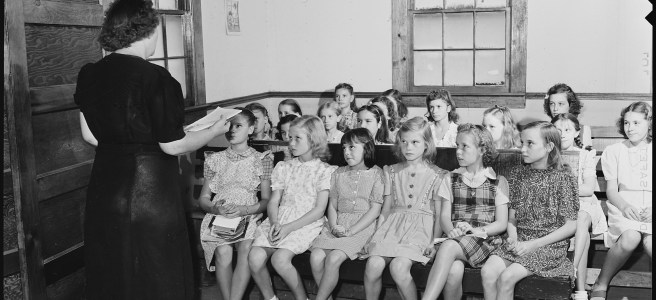
Mrs. Soper was my first grade Sunday school teacher.  If you had told me then that she was 112 years old, I would have accepted that without reservation.  I’m pretty certain she had taught the first grade Sunday school class for 86 years already by the time I arrived.

One Sunday morning, Mrs. Soper was asking for a volunteer, probably to lead the prayer.  No one jumped at this golden opportunity, so I started pointing my pudgy six-year-old fingers at each member of the class and reciting, “Eeny-meeny-miny-mo, catch a nigger by the toe . . . ”

Mrs. Soper pointed her gnarled, 112-year-old finger at me and snapped, “We don’t say that word.”

I slunk back into my chair, cowed and embarrassed.  There is no greater humiliation for a budding comedian than to learn that an attempt to be funny is not only not funny but horribly inappropriate.  Besides, I had enjoyed the protected status of preacher’s kid my entire life.  It was the rare and courageous adult who dared chastise me publicly.  Well, Mrs. Soper was both rare and courageous (in addition to being the mother of the church treasurer, the woman who wrote my father’s paycheck).

Until that time, the little engine in my spirit that could contemplate issues of social justice had only followed the track laid by my family.  In an instant, Mrs. Soper threw the switch and sent me in a new direction.

I have no idea if I ever said that word again in my childhood (I know that I haven’t as an adult, with the rare exception caused by academic or narrative necessity, as evidenced above, and usually not even then).  I would not be surprised if I did, but I can tell you one thing with certainty: I never said it again without thinking how disappointed Mrs. Soper would be with me.  In fact, every time I hear that word to this day, whether coming from the mouth of one of my students or in a rap song, I think of Mrs. Soper.

It’s not an easy responsibility for an adult to undertake, to transform a child’s ignorance into a choice they can never make again without knowing it is a poor one.  I have done it in the past when my nieces were younger, and let me be the first to tell you, I didn’t enjoy it.  It was embarrassing for them and unpleasant for me.  But, I also know they remember those instances as clearly as I remember Mrs. Soper.

The writer of the Proverbs said, “Train a child in the way (s)he should go, and (s)he will not depart from it.”  I think the part of the verse that gets most overlooked is the concept of the true way to go.  I learned lots of stuff in church that I have long since abandoned, but I have never departed from the track Mrs. Soper switched me to.

From now on, if anyone should ask where I get my passion for social justice and equality, I know exactly what to say — “Mrs. Soper.”  She planted the seed which my life experiences have watered and nurtured.  But, she planted the seed.  Would that we all  contributed to the gardens of the young people in our lives in such a profound way.

Write It Down

In my World Literature class, we spend some time studying biblical literature, as well as literature that predates the Judeo-Christian bible.  I explain to my students that the ancient Hebrews weren’t really all that impressive.  They were a wandering group of shepherds who only produced two great kings — David and Solomon.  They didn’t create great urban centers along the known world’s great rivers.  They didn’t develop an alphabet or contribute medical, architectural, or economic developments to humanity’s knowledge base.

There were far more complex societies such as the Akkadians, Sumerians, and Egyptians which left their mark on the ancient world.  In short, the Hebrews didn’t do much of anything, except . . . they wrote their story.

 As I was going through old boxes of pictures, cards, and letters yesterday, I ran across the beginning chapters of my father’s autobiography which he had mailed to me in 1999.  It was mostly random memories of his early childhood and teen years, but chock full of long-past moments now fascinating to me.  His homerun record in Little League.  The first family vacation to Florida.  Driving himself to get a haircut when he was ten (with his father’s permission to take the car).

I also have some journals of sorts that had belonged to my maternal grandfather.  I say “journals of sorts” because grandpa was far too busy to spend much time in a writer’s necessary pondering.  He kept pocket-sized datebooks in which he would record events.  When he died, my mother gave each of us the book from the year we were born.  On April 5, 1964, grandpa wrote, “Debbie born.”  That’s it.  Just those two words.  Yet, when I read them, in his handwriting, I can imagine him pulling out his datebook after receiving the call and making a notation of the fact that I had arrived.  By writing those two words, he put a pushpin into the map of time, a reference point that somehow validates that I was here.

I love blogging, but there is something precious about my personal journal.  It tells my story in a much more intimate way.  It explores my relationships and personal process in ways that I may not always feel comfortable making public.  I love writing a secret to the universe and wondering what will happen to those secrets.  Will someone read them one day?  Will a niece or nephew discover them when I have passed from this earth?  Will a stranger, picking through the garbage after the estate sale, pick up a plain brown-covered book I hunched over years before and find it interesting or even perhaps instructional?

Write your story.  In whatever way you desire.  Whether it is a two-word comment in a tiny date book or an epic narrative.  I can’t promise you’ll influence the world in the way Moses has, but you just might leave your children the most precious part of you, memories you know so well but which will be a secret kept from them forever if you don’t write them down.

The Last Age of Innocence

In 1973 I was nine years old.  It was a time of banana-seat bicycles, The Brady Bunch, and that bad, bad Leroy Brown.  I remember the latter especially because Tracy Shapow and I would play the song over and over again on her portable record player in her garage and take turns “singing” the lead.  Tracy Shapow lived just across the street from me.  We would ride our bikes half a mile up Studor Drive and cross a very busy two-lane highway to get to the Seven-Eleven and buy candy.  And our mothers didn’t even worry.

I would play outside on summer evenings until dusk would tip-toe up on me from behind and suddenly throw a blanket of darkness over my head.  An acceptable answer for a mother inquiring about the whereabouts of her child in 1973 was, “Oh, somewhere around the neighborhood.”

To the best of my knowledge there was no fence around the playground at Thomas White Elementary School.  At recess we would scatter to corners of the school yard that seemed quite a distance away and certainly not meant to be a part of the official playing area.  There was the pavilion where my sister married Henry Ozeritis in the sixth grade (much could be accomplished during recess).  We were well out of the teacher radar range there, but somehow we always managed to know exactly when to head back to school in order to beat the bell.

In one isolated spot on the playground, there was a large round cement section like builders use for underground sewers, or so I assume.  It was about six feet long and tall enough for a nine-year-old to walk through.  If you crawled up on top, there was a metal pipe that had been somehow inserted into some sort of hole and was bent just right and just long enough for a fourth grader to leap out and grab and swing from.   Some days this was more popular than walking across the top of the monkey bars.  Other days it was deserted.  As it was on that day.

On that day, I leaped and swung, leaped and swung, and then just before leaping again realized that I was completely alone.  The closest person was well outside of hearing range.  I hesitated, looked all around me in a complete circle to make sure no one was there, and then I said it, almost as a whisper.   “Fuck.”  And then louder, with more authority, and for the second time in my life.  “Fuck.”

And leaped and swung, and leaped and swung, and leaped and swung.

My First Best Friend

Well, I have awoken from my turkey coma and have a few quiet moments to purge some thoughts.  This time of year always makes me reflective.  I think about family and personal history and events, both joyous and traumatic, that I have been witness to and/or participant in.  From now until, oh, about January 5th or so I will be never too far from some memory or the other.  Probably not the best testimony for “living in the moment,” but true all the same. 

So I have decided to begin a series of Memoir Posts, sprinkled throughout other posts and occurring simply as they come to me.  And so we begin.

I had my first broken heart when I was six years old.

My family was moving from Indianapolis, IN, to Saginaw, MI, because my father had chosen the nomadic profession of ministry.  Some ministers’ families stay put, or so I hear, but we had about a four-year expiration date on most of our hometowns.  We had moved to Indianapolis from my birthplace of Metropolis, IL, when I was two.  I didn’t remember enough about Southern Illinois to miss it.  But, at six I had formed attachments and felt the pain of them being torn asunder.

I only remember two things about Beth Ann Barker, her name and the fact that I cried for her as our Plymouth Duster left the Indianapolis city limits.  And even as I write that sentence, other snippets come to me.  Her father’s name was Ronald; we called him Ronald McDonald.  I believe I had attempted a sleep-over at Beth Ann’s house once, but cried so for my parents that they came to get me in the middle of the night (it was probably 9:00 p.m., but my memory is that it was the middle of the night).  I think she had an older brother, but that memory is as unclear as a Rorschach blot.

Beyond that, nothing.  I couldn’t even tell you what Beth Ann looked like at that age, let alone pick her out of a line-up today.  I don’t remember her house or her clothes or even the color of her hair.  I just remember that she was my friend and I had to leave her and would probably never see her again.

That scenario would play out time and time again in my life.  Four years later when we left Saginaw, two-and-a-half-years after that when we left Springfield, MO, then leaving Bay City, leaving Saginaw Part II, leaving Denver.   Crying over Beth Ann, crying over Martha, crying over Denise and Michael, crying over Jerilyn, crying over Stephanie.  My heart breaking again and again.

It’s no wonder I had to work so hard to grasp any sense of continuity in my adult life.  Every now and then, Susie and I will be in Kohl’s or Target or Kroger and she will run into an old friend and stop and chat.  After the conversation ends and the old friend walks away, Susie will say something like “We went to high school together,” or “I’ve known her since kindergarten.”  The idea of going into the grocery store and happening upon someone whose thread first wove into the tapestry of my life 40 years ago is as difficult for me to imagine as vacationing on Mars.

As a young adult, I changed (insert any of the following: colleges, jobs, houses, partners) like I changed socks.  Change was not something I had to learn to accept.  It was familiar and oddly constant.   But it eventually became as old and tiresome as living 50 years in the same house you were born in.  I became bored with change and sought something new and interesting: stability.

I have now lived in this house for six years.  I have had same job for nine years (and the same “second” job for 11).  I have had the same partner for seven-and-a-half years.

I don’t want to move.  I don’t want a different job.  And, as Paul Newman used to say about Joanne Woodward, why would I want hamburger when I’ve got steak at home?

The carousel ride has turned into a porch swing.  I embrace the change of seasons as I watch them from the same spot year after year.  I don’t miss the irony in the fact that Interstate 40 is in my backyard, that I can sit on my deck and watch others in motion while I sip tea.

And sometimes as I sit there, I remember just how much it shattered my heart to leave Beth Ann Barker.