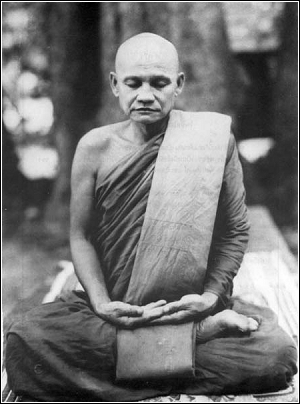
Letting Everything Go

Ajahn Chah (1918 – 1992)

Letting everything go is the spiritual concept I return to over and over. I have spiraled up through the years, elevating my consciousness, but always returning, again and again, to the need for something to be released and the lessons brought by letting go.

The practice of releasing attachments started as a wall against which to kick and scream and beat my head. Over time, it became a closed-bud promise, the kind I knew would bloom one day but still tightly shut against full surrender. Eventually, ever so slowly, the lotus began to open, and wisdom wafted forth like a fragrance in the air.

The Thai Buddhist monk, Ajahn Chah, said, “When the heart truly understands, it lets go of everything.” For me, the opening of the lotus was initiated by the first part of that sentence. During times when releasing everything seemed downright impossible or even a bit irrational, I would choose to focus on a deep and consuming desire for a heart that truly understands. If I couldn’t quite let go, at least I could lean into love. And when I couldn’t do even that, there was always grace.

Grace is when our hearts feel the pull of the divine even while we maintain our death grip on our ego’s desires. Grace is the sacred ability for even our attachments to become guideposts to spiritual awakening. Grace is knowing we are only love even while still feeling the pull of our needs and wants and attachments.

Ajahn Chah also said, “Anything which is troubling you, anything which is irritating you, THAT is your teacher.” And the primary lesson it teaches us is that all the time we’re thinking it has its claws in us, we actually have our claws in it. We can open our hand, open our heart, and learn once again the freedom of letting go.

And when we’ve let go of everything, . . . then we are free.

Why does God . . .

. . . allow suffering?  If you go to Google and type in “Why does God,” the first autofill answer you will get is “Why does God allow suffering?” When I clicked on that option, I got over 77,000,000 results in half a second.  It seems a lot of people have asked that question and almost as many have tried to answer it.  And they’ve been asking this question for a long time.  

Epicurus, a Greek philosopher who lived in the fourth century BCE, was asking this question before Jesus even walked the earth and long before the Prophet Muhammad received his revelations. Epicurus drew a sharp line between the potential for God’s strength and the capacity for God’s compassion.  He asked, “Is God willing to prevent evil, but not able? Then he is not omnipotent. Is he able, but not willing? Then he is malevolent.” In other words, a God that would allow suffering he is powerful enough to stop must be cruel.

Ooof. 

On my Google search, the first page of the 77,000,000 responses comes from mostly Christian sources.  The “answers” put forth included “Well, God doesn’t cause suffering, but he allows it” and “Suffering is a way to enter into relationship with God,” and “The message of suffering is that life is hard, but God is good.” That last one especially seems it might be of little comfort when tragedy strikes. 

The best answer I found was one that recognized the compassion and unity that can result from suffering, but also acknowledged that it’s a mystery. Compassion and unity are vital concepts for a fully realized spiritual being, and it’s true that they often seem to rely on crisis and division to act as springboards for their creation. But an omnipotent God could surely find a way to inject my soul with compassion rather than through another’s suffering, right?  Though if no one ever suffered, would we even need compassion?  

Now, in full disclosure, I want to make it clear that I do not have the answer to the question of why God allows suffering. And, I would suggest that you proceed with great caution around anyone who claims to have that answer.  

I’ve had a few times of tragedy in my life, and I know that doesn’t make me special. It doesn’t make me different from you, and perhaps it even offers ground where we can meet. I may not know your pain or your story, but here are nine things I do know, and I can only hope they provide comfort, if not insight.

  1. I know that sometimes tragedy brings out the best in us. 
  2. I know that although there may not be an adequate reason we might accept to explain tragedy, no grand purpose birthing a trauma, there can still be great lessons and awareness that come from these events. 
  3. I know that although my pain is real, my pain is not me.  
  4. I know that it’s possible to be on a spiritual journey and be mad at God. In fact, it can be among the most transformative of experiences if we retain just an inkling of faith. A mustard seed, even. 
  5. I know that love is God, and the tragedy of my past is a prime contributor to the degree of love I can bring into another’s place of pain.
  6.  I know that my suffering has created compassion and tenderness and gentleness in me that I’m not sure I would have had otherwise.
  7. I know that, as the Buddhist teacher Jack Kornfield writes, “The question of human suffering is central to the journey of grace and redemption.” 
  8. I know that I would be nowhere without grace and redemption.
  9. I know that awakening to the awareness of our higher Self, our Buddha nature, our Krishna consciousness, our Christ consciousness, can bring freedom.