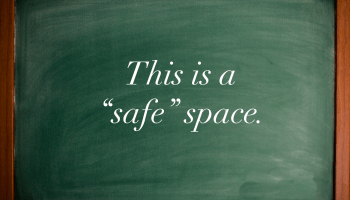
How Do You Say “Safe Space” in Conservative?

The student held the placard boldly over her head.  “No Safe Spaces Here,” was printed in handwritten scrawl.  The protective part of my Aries nature kicked into high gear.

Those of us who work in higher education operate from the position of in loco parentis, a Latin term meaning “in place of the parent.”  Our students are adults (barely) and have a lot of freedom, but they are also in our care.  One of the first responsibilities we have is to keep students safe, hence the endless emergency drills and sexual harassment trainings.

Seeing this sign, I thought first not of the person holding it but of the students walking by and reading it.  I summoned all of my authoritative energy and approached the small band of protestors.

In the short exchange that ensued, I became aware that our primary difference rested in a basic communication challenge.  We were, quite simply, defining terms differently.  I define “safe space” as a place where people of diverse races, religions, sexual orientations, and ideologies can relax in a sense of security and personal safety.  This group of students defines “safe space” as a pansy-ass kowtowing to political correctness.  They interpret the phrase to mean a restriction of free speech, while I see it as fertile ground for free speech, albeit while maintaining a level of mutual respect.   They see it as a liberal agenda to make everyone warm and fuzzy (which is a perfectly fine agenda, in my personal opinion), and I see it as the very philosophy that allows them freedom to express without fear.

Despite the difference of definitions, I had to wonder why anyone would ever want to send the message “No Safe Space Here.”  Do we only allow dangerous spaces here?  Is this a demand?  A warning?

Interestingly enough, I had already been thinking about definitions this week.  In fact, I was toying with the idea of posting a Facebook request to my conservative friends to define “conservative” as they understand it.  I was beginning to think that perhaps the real problem is that we simply define our terms in different ways.

I think many conservatives define a “conservative” as a fiscally-careful, small-government, bootstrap-pulling individualist while many liberals would define a “conservative” as a racist, homophobic, misogynistic, gun-loving bully.   Conversely, I think many conservatives define a “liberal” as an out-of-touch, tree-hugging, politically correct socialist while many liberals define a “liberal” as an intelligent, sensitive, big-tent/big-picture lover of democracy.

We are quite simply speaking two different languages.  We’ve created code words and buzz words and spun words until we sometimes aren’t quite sure what our own side is saying, let alone the other.  It is so rare to hear a politician speak in a simple, declarative manner that we become practically weak-kneed when they do.  We ask for clarification on matters, the politicians dance around it, and then we whimper back into the woodwork with a mild, “well, ok, then.”

Before I left the exchange with the protestors, I turned to the few students who had gathered.  “My office is SRB 317.  It is a safe space if any of you ever need one.”  I don’t know how to fix the linguistic challenges we face as a nation, but I do know how to do parentis, and I’m a flat-out genius at loco.  While we figure it all out, my students will have a space space.  And we can play with puppies there.  And sing “Kumbaya.”

Elect to Love

“It’s really a wonder I haven’t dropped all of my ideals, because they seem so absurd and impossible to carry out.  Yet I keep them, because in spite of everything I still believe that people are really good at heart.”  ~ ~ Anne Frank

Like so many others, I woke up this morning enveloped with despair.  How could this be?  What didn’t we do?  What does this say about us?  Something that seemed so certain slipped out of our fingers as surely as if we were trying to clutch at vapor.  And then, along the way, there have been moments of such sweet serendipity that I have been moved to tears in their preciousness.

One of my first acts of the day was posting something to Facebook.  It was my attempt to set the tone for how I would respond to our new reality.  I wanted to convey a peaceful resolve.  A family member from the other side of the political spectrum commented in appreciation for my stance.  We sent a few kindhearted messages back and forth.  I asked for his help; after all, his party won, and those in my tribe need folks like him more than ever now to hold our new leader to the highest standard.  He assured me he would do so.  And then he wrote, “Deb, I lock arms with you.”

At first, I admit, I felt the internal confusion that comes from seemingly mixed messages. I wanted to say, “How can you cast your support in the direction of one who promises to restrict and remove my freedoms and then say that you lock arms with me?”

And immediately a new thought fell in line behind that one.  I realized that I had a choice.  I could chew on the mixed message or I could savor the sentiment of unity.   I could focus on the confusion or I could focus on the connection.

In every moment, we are called to be better people.  We are called to love each other with a spiritual fire.  We are called to shine a light on the best in each other; and we are called to remind each other that everything else is not the truth of us.  We are called to inspire and uplift and encourage.

But also in every moment we are given another option.  We can dive into the depths of suspicion and discontent.  In every single opportunity we have to shine, we can decide on the darkness.

We have to choose.

I gathered my students in a circle this morning and talked to them openly and honestly about this election, about the fear a lot of people have, and about the personal impact it has on me as a lesbian.  I told them that nothing about this election can take away our freedom to decide each morning just how we want to show up in our world.  I told them that love is still stronger than fear.  I told them that love comes a lot easier when your side wins, but the love that you have to reach into the depths of your soul for and muster in the face of defeat is the one that is actually, bygod, love.  And I told them that no matter how they feel today, whether joyous or forlorn, we’re all still going to make it through.

In other words, I told them that I lock arms with them.  And we all felt a little better, a little safer, and a little more assured that everything would be okay.

Like I Want To Jump Out of My Skin

According to WebMD, “Irritability and feelings of sadness are the most common emotional symptoms of menopause.”  And to be completely truthful, it so totally pisses me off that some asshole at WebMD thinks they have a flipping clue what might be going on with me that I may cry.

Writing this at all is evidence of the intensity of the aaarrrggghh-ness. It may be that I courageously face alone, in admirable fashion, any less than happy and pleasant (read: in control) feeling.  Or it could be that I am completely incapable of emotional honesty.  I haven’t figured out which.  All I know is that I don’t readily admit to depression, sadness, or pissy-ness.  And even if I do admit to them, I insist on using my Aries ram-like approach to barreling through.

But, all of that — the avoidance, the denial, the forging ahead — it’s just not working.

Sometimes I feel deeply, deeply sad.  There might be a reason — a reason that in prior days would have made me slightly sad, but nothing I couldn’t handle — or there might not be a reason at all — that particular pink of the sunset, or the way Buddy nuzzles my neck and reminds me of past nuzzles, or just driving down the damn road. Let me be clear about this one thing: this is not depression.  Are there elements of depression at play?  Perchance.  But, this is something different, a specific shade of sadness that introduced itself to me in the past year or so.

And let’s talk irritability.  If you don’t like colorful language, you might want to stop reading now.

EXAMPLE 1:  People in Tennessee are usually polite drivers.  They will stop to let someone turn into the flow of traffic.  I have to turn left out of my apartment complex, and often some guy, usually in a pickup truck, possibly because 1 in 3 people in Gallatin, TN, seem to drive said vehicle, will be directly across from me waiting to turn right.  He has the right of way.  More times than not, however, he (always a different he, but we’ll make him an EveryHe for now) will motion for me to go on ahead. It is possible that, once or twice, I have rather forcefully motioned him to go first and expressed something like this out loud (though thankfully I am my only audience): “Motherfucker!  Just drive, you fucking moron!  Jesus!  If you’d just follow the fucking rules of the road, everything would flow just fine.  You know what happens when you break the fucking rules?  Accidents fucking happen.  Fucker.”  (Please note that this is what happens when someone is being nice to me.)

EXAMPLE 2:  Another car example.  Lots of emotion gets expressed in the car, probably because I don’t have anyone else around to witness what an unbearable ass I’m being.  This example most often happens when in the left turn lane waiting for the green arrow.  The guy at the front (or any person in front of me) does not proceed with appropriate haste when the light turns, possibly creating a situation where not all cars will make it before it turns back to red.  Appropriate haste would mean zip-zip.  If you are not the first person in line, then appropriate haste means staying within 5-10 feet of the back bumper of the car ahead of you.  When appropriate haste is not displayed, my juicy monologue goes thusly:  “NOBODY in the world but you, buddy.  NOBODY in the world but YOU.  Fucker.” (The last word is like the “amen” to my prayer.)

EXAMPLE 3:  Could happen anywhere.  Ordering food through the drive-thru.  Engaging in seemingly benign conversation at work.  Walking past a stranger on the sidewalk.  Nothing happens.  I just open my mouth and absolutely anything I say sounds like the bitchiest thing any human has ever uttered.  I can hear it.  In my head I’m saying silently, “Stop talking.  Just stop talking.  Close your mouth now.  Say nothing.  Fucker.”

I’ve heard the entire playlist of the Pandora Deva Premal station 762 times at least.  I light incense and candles.  I snuggle my puppy.  Sure, I could do some more exercise (which makes me precisely like every other human I know), but I’m not a total slug.

I’ve rammed through until my head hurts.  So now I flip on the klieg lights and say, “Here it is.”

I have no answers.  This essay/rant/diary entry has no ending.  It just has an approach I’ve never tried before: admitting emotional imperfection (gasp).  So, sometimes I’m deeply sad.  Sometimes I’m a real snippy bitch.

I’m 52 years old, and I’m in menopause.  Fuckers.

True North

A satisfied life requires a few basic elements — love that is undefinable, work that compels, time for whatever expands us, and music, always music.  We could crawl around on Maslow’s Hierarchy of Need and toss in shelter, security, and self-esteem, but let’s not go crazy here.

Another core element to a satisfied life is one that often gets overlooked: one or more guiding principles.  Guiding principles are often seen as a requirement for living a good life or a moral life (whatever that is).  The satisfied life, however, is more readily connected with items that fill or nurture us — love, work, time, music — rather than that which directs us.

Guiding principles are the border collies of the spiritual journey.  They nip at our heels when we wander too far into the land of compromise.  They outrun us and come up on our blindside every time we try to turn a different direction.  They guide us into the safety of the barn every night . . . if we let them.

In this age of labels, we can become deluded into believing that the groups with which we identify can provide some of the above services.  But the lines aren’t as clear anymore.   In his essay Self-Reliance, Ralph Waldo Emerson wrote, “If I know your sect, I can anticipate your argument.”  But, I’m not so sure that’s as true as it used to be.  Does Christian mean what it used to?  Does Democrat?  Single?  Southern?  Race?

Being a Democrat or a Republican might not guide me to do what is right and good and true, but a principle will.  One of my principles, for instance, is an abiding belief in the equality and unity of all people.  Because of that, I stand against racism, sexism, ageism, homophobia, xenophobia, religious intolerance, etc.  I don’t have to make a decision on each of those.  I don’t have to consult a party platform or a church tenet.  I simply have to establish my principle and every decision after that flows with ease.

In an era of fake news and fallacious rhetoric, we need personal principles more than ever. I mean, what if, just what if, we decided that one of our guiding principles was the idea that loving one another was more important than politics?   What if, just what if, we decided that our shared humanity was higher up the priority list than our religious differences?  And what if, just what . . . if . . . , we decided that honoring and respecting each other was more important than winning a damn election?

That just might be . . . satisfying.