Ruth

(For George Floyd, Ahmaud Arbery, Tamir Rice, Michael Brown, 
Philando Castile, Eric Garner, and the countless others.)

I want to tell their stories,
remind the world
how they were
murdered by the system,
but when I try, all
I can think of is
Ruth.

The whitest white and the
blackest black are found
in churches and their
affiliated colleges.
I remember three Black
people in the entire school
my freshman year,
and one was my
assigned roommate,
Ruth.

I was 18. Twelve hundred
miles from home. Everything
seemed strange, but Ruth seemed
strangest of all. I was homesick.
I was sheltered. I was incapable
of seeing beyond a self I barely
knew, and I devised a way
(it wasn’t hard) to get reassigned,
moved away from
Ruth.

Every justification
I can offer (and I’ve made
a long list over the years)
drips with privilege.
Poor white girl far
from home, feels
uncomfortable, and every
administrative cog in a
great machine lurches
into action to set things
right for her.

I was unawake,
but aware enough to be
embarrassed.
Every time I saw Ruth,
she gave a sincere smile,
and she waved
and she said hi,
and she acted like
nothing had happened,
and I would feel
the disgrace
anew.

I silently bore the shame
of my inadequacy.
It was my secret.

Years later, I
finished two degrees
at an HBCU across
town, “the Black school.”
I learned the
greater part of all
I know from Black
scholars. I got smart
enough to shut up
and listen, to observe,
and to learn.

Then I began teaching
at my alma mater,
and to my knowledge,
not one of the Black
students in my classes
ever asked to be reassigned,
moved away from
me.

In order to share the
Story of Tamir and
Alton and Ahmaud,
I have to start with
Ruth, and I have to
understand that the
same system that
killed them is the one
that found a new
roommate for
me.

If I could find Ruth, I would
fall to my knees and
beg her forgiveness.
And the Ruth I remember
would give it, I have
no doubt.
I have looked for
her and I have hoped
for a chance to
be absolved.

It has not arrived,
and I’m glad it hasn’t,
for I need to stay
unpardoned,
unacquitted.
That is the energy
that fuels me now.
Ruth owes me
nothing. I owe her
a lifetime of fighting
the unpardonable.

I don’t equate
my actions with a boot
in the neck, but I have
come to accept they
are siblings.
Were they not, Eric and
Philando and Michael
would not have
told me from the grave
that I have to start
with the story of
Ruth.


© 2020 Deb Moore, All Rights Reserved
The Middle Age

I have a predilection for melancholy,
a generous bent toward nostalgia,
and I surrender completely to 
isolated flashes of memory 
in the gloaming. 

I’ve spent hours in meditation,
bending toward the present,
then settling into a place
of peaceful nothingness
in the moment.

I’ve loved so many ways,
the love of blood, and the
love of heart, and the love
of so much more and 
so much less.

I’ve aged into a life I like,
a daily rhythm that fits
a soul like mine, that craves 
both experience and time 
to write it.

I am middle-aged, no longer
a tree climber or a speed demon,
no longer willing to play fast
and loose with your heart
or mine.  

I have learned the lessons of
my time, and I have become
less of what I wanted and 
more of what I needed, 
and I’m happy.

But sometimes in the half-light
of dusk (one can’t meditate
every moment) I think of 
days long gone, and I 
remember you.  

© 2020 Deb Moore,  All Rights Reserved

The Moment

I’m reading a book about communists
(poet’s disclaimer: I am not a communist,
though I’m not sure if it says more

about me or our society that I feel
I must disclaim; I don’t dislike 
communists, and in fact, I could almost

be one if push came to shove,
but I’m not, you see, just a plain
old run-of-the-mill Democrat

and proud of it, though I have 
good friends who are conservative
Republicans, and they are, generally,

quite lovely people) and in this book
so many of the people profiled
speak about THE MOMENT,

the moment when they saw
clearly and heard the clarion 
call of the ideal and felt 

connected to those who also
believed, and it was beautiful,
and it was life-changing, and

they never forgot it, and nothing
since has ever come close,
and I thought how very much like

religion it sounded, like a 
Damascus road experience, 
blinded by the light and all,

and then I thought about today
and how we’ve all become
evangelists for something, and I’m 

not saying that we shouldn’t stick
to our convictions, but maybe,
just maybe we could consider

how fully we ate of the
flesh and drank from the cup
of our personal gospel. 

© 2020 Deb Moore,  All Rights Reserved
The Marigolds

Brick wall whitewashed to look 
new old. Worn floors refinished, 
wood polished, shining. Mats 
a safe six feet apart in this, our 
first class in the yoga studio 
since being forced into solitary 
practice seven weeks ago. 
Faint acoustic music from the 
Bluetooth. Benign renditions of a 
change to come and my sweet
lord. Diffused patchouli mist 
tussles with the alcohol in 
homemade hand sanitizer. 
The instructor tells us when 
to breathe.

I was in India when the pandemic
took over the world.  One day
Holi, slapping powdered color on
friends and strangers alike, rubbing
it into their hair, more intimate in the
playfulness than we would be
otherwise. Bollywood bass lines 
thumping the speakers. Colors running
in rivers of sweat. The next day, 
weighing options. Can we get back 
into the States? I don’t want to
leave a thousand kindnesses. The 
drumming of the Shiva temple in the 
morning.  An entire nation of 
incense and marigolds.  Breathing, 
rhythmic, human yoga.  

Inhale, she says, arms above 
your head. Exhale, fall into forward 
bend, and we comply, an army 
of six following field commands in 
unison.  The tips of my fingers 
feel the hardness of the thin-matted 
floor.  In the position’s hold I 
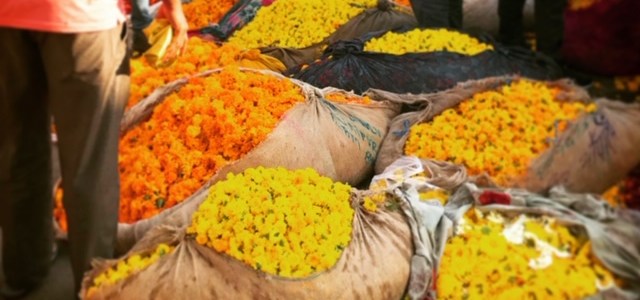
think of the flower market in Jaipur, 
mounds of marigolds, like walking 
through the clouds of a Hindu heaven, 
fighting the urge to jump into one, 
the petals cushioning 
the fall.

© 2020 Deb Moore,  All Rights Reserved